The Gracefulness of Being

Perhaps it was the title: “How to Age Gracefully.” I was hopeful that this was a question more so than a statement for I’m not getting any younger, and now in my 80s, a time when many of my peers have sequestered themselves into a recliner or couch, I sense a need to keep charging forth creatively with an intense fear that my slowing down is the first step toward the grave. Following, perhaps, a lengthy time of acute boredom!

For the past few weeks hours have been spent in my wood shop and studio preparing items for the area Christmas Markets, and then an old friend, Dale Pederson, arrived with a pickup full of pre-cut timbers to install a planned canopy over our studio door to keep snow and ice away from the entrance. We were both fighting the calendar and weather.

In trying to balance all of that, by bedtime for three straight nights my mind and body was a wreck. There was nothing graceful about it, or me, and yes, on one of my ventures into the wood shop to rip a board on our last afternoon a misstep sent me sprawling across the concrete floor. Grace? Hardly. Fortunately my head missed a standing concrete block that was off to one side. Does that count as an old man’s fall? 
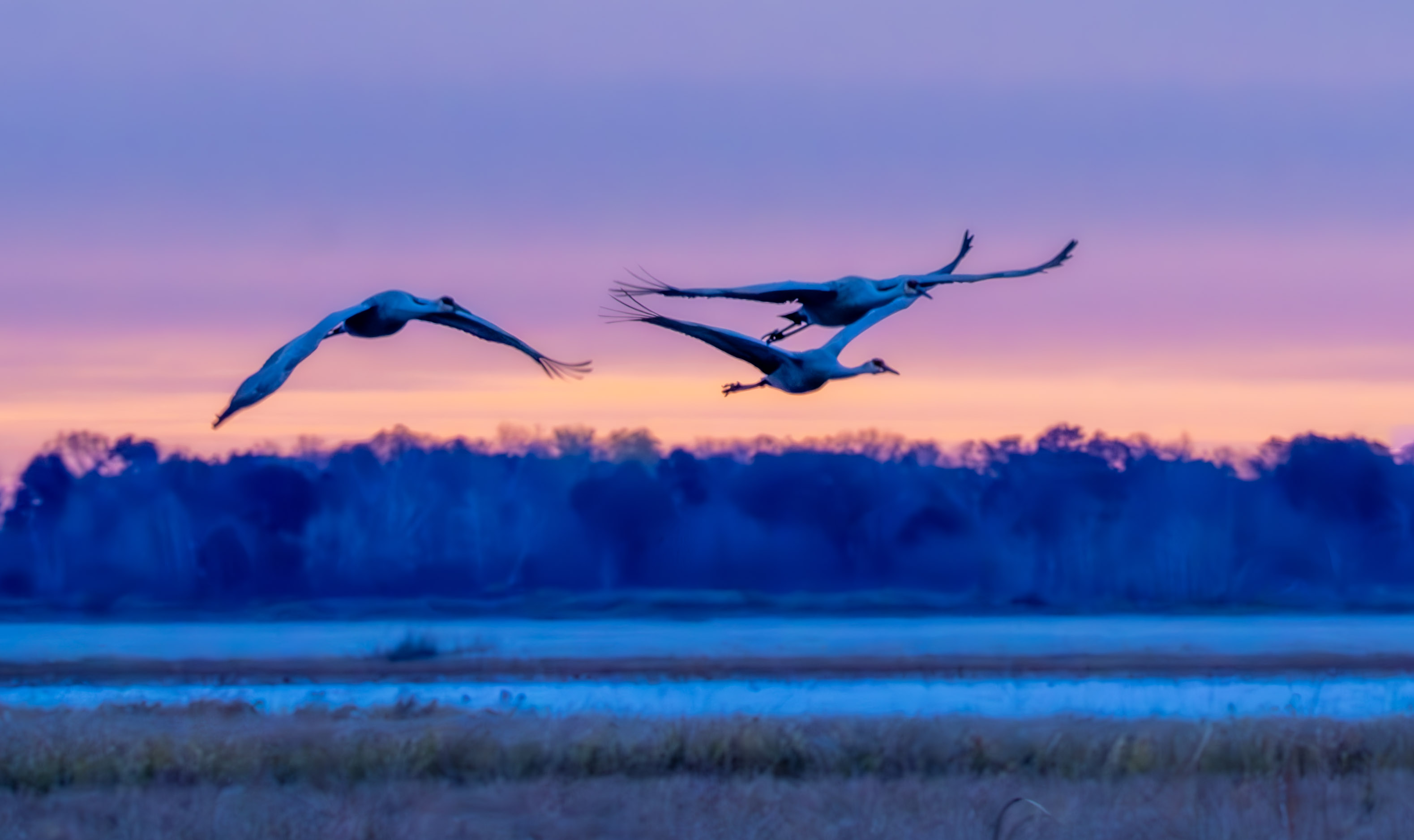
Grace is what I sometimes find in nature …

A few days later at the library while returning a great nonfiction book called “Sea of Grass,” an in depth portrayal of the complete destruction of American’s vast prairie between the Smokies and Rockies by Dave Hage and Jo Marcotty, this new book … “How to Age Gracefully” … seemed to jump off the shelf and into my waiting hands. 

Like Hage and Marcotty, the author, Barbara Hoffbeck Scoglic, was also a former reporter for the Star Tribune. My wonder was if my quest for grace was irrational, if not impossible; is there an emerging path for my unstoppable aging? Scoglic’s was an interesting read, though basically she wrote a day by day journal of her moving into an assisted living senior center. Now in a wheelchair, and being completely unreliable on her feet, Scoglic recounted various conversations and personal memories along with a morning ritual of coming off the elevator to see who might have survived for another night.

Perhaps I missed the “graceful” piece. No, her’s was not a “how to” effort. So my venture continues as I wander down a different path. 

Grace … a moment of tenderness of a burly bison cow with her newborn calf …

While I was working with Dale, and on various pieces for the Christmas Markets, an old conversation from years ago kept cropping up. It was on a cold, windy and snowy day “way back when” that I unloaded my collection of items from my van into one of Montevideo’s Chippewa Village historical buildings to discover my display partner was a 91-year-old man, a flat-plane wood carver and painter of Norwegian trolls, gnomes and Ole and Lena farm characters. After our introductions and getting set up, I asked the elderly artist about his work  and what kept him going.

“At my age,” he said with a wry smile, “what else would I do?”
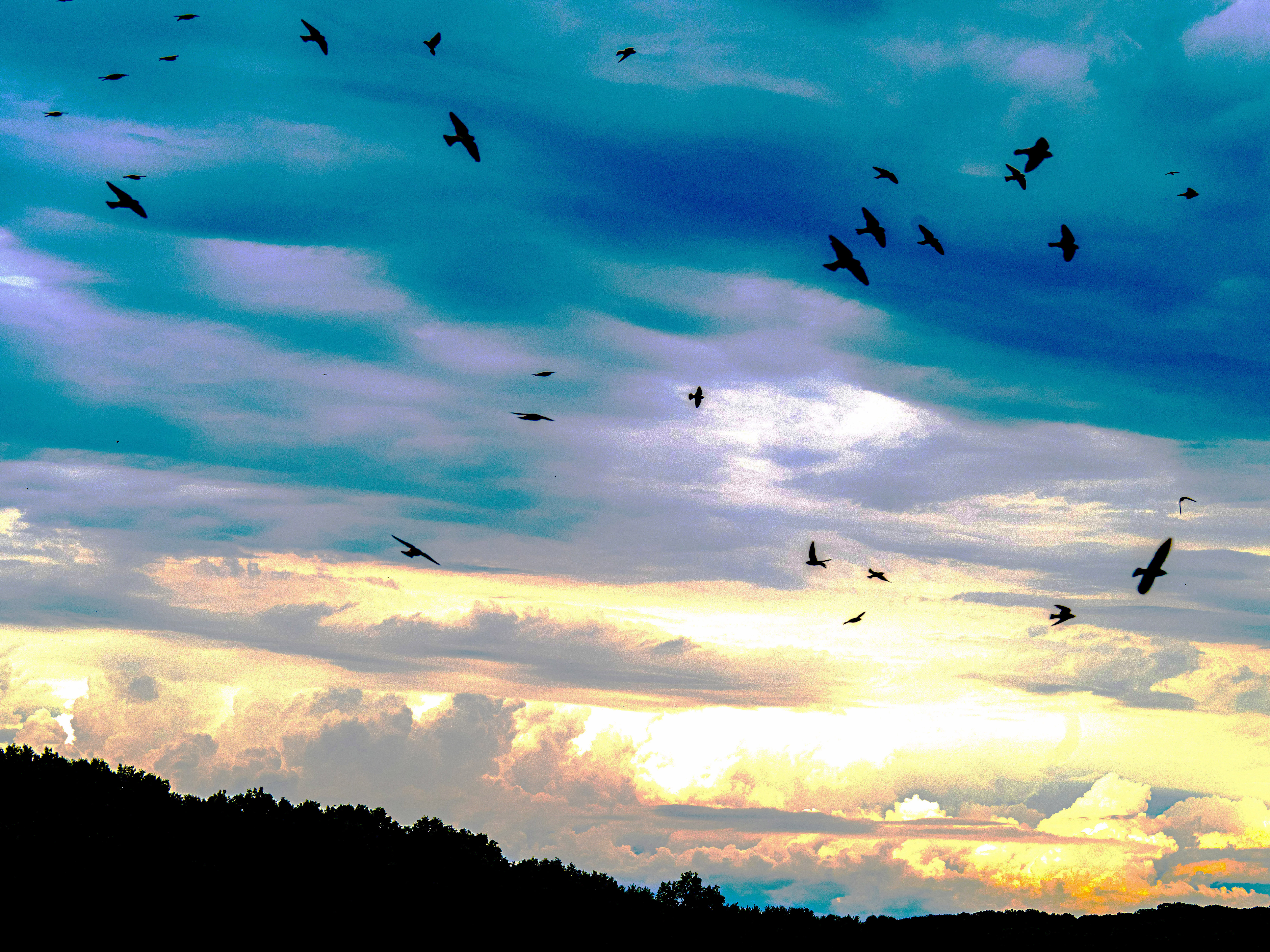
Grace … when unexpected swallows appear to give ambience to an image …

Often I think of him, and have told that story to other artists who confide that they’re thinking of retiring, of giving up. Nowadays I sometimes wonder about myself. It’s not so much about aging gracefully, whatever that means, rather than wondering what else would I do? The walls and panels in my studio are full of canvases, and I make numerous smaller items featuring my photographic work. Over these past few weeks I’ve poured through a few thousand images created over the past 15 or so years, from when I retired from the country weekly to begin my efforts of portraying the last one percent of an ancient and nearly completely destroyed original prairie pothole biome. 

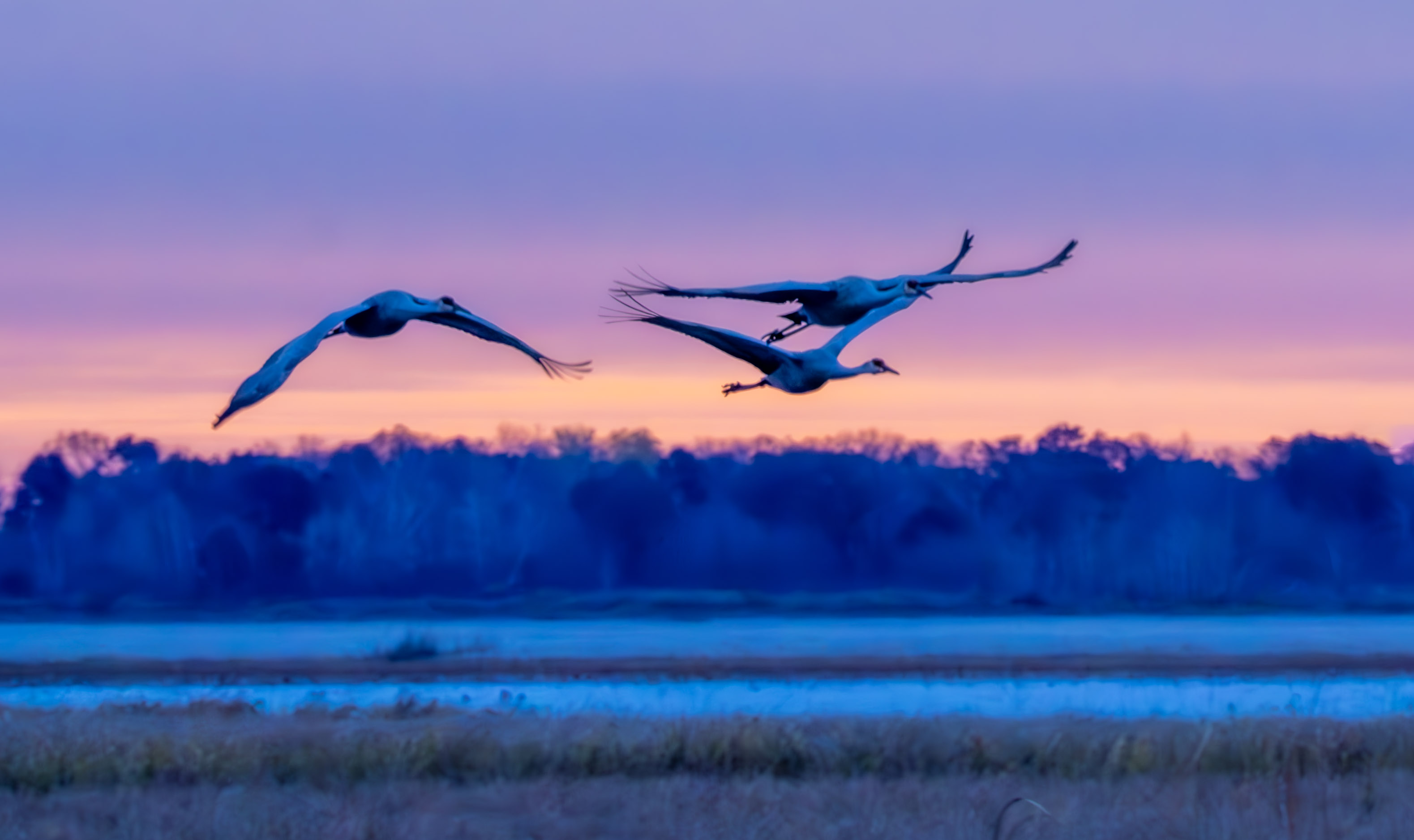
In so doing I sometimes find a choice image previously overlooked, or marvel at something long ago printed onto canvas and sold, and still hopefully hanging on someone’s wall. I also have thoughts of why continue? Do I need more images? Yet, quitting seems so unreasonable since I still throughly enjoy working with the magic of natural light, composition, ambient colors and those quirky surprises your find in nature. Those valued moments of internal celebrations when all those artistic elements come together … like when a trio of Sandhill Cranes flew over me recently at Crex Meadows in the ambient softened colors of a prairie sunrise. Yes, a portrait of grace. Color. Movement. Poetry. Nature. Perhaps finding grace in the imagery is more than can be expected. Then there’s this: What else would I do?
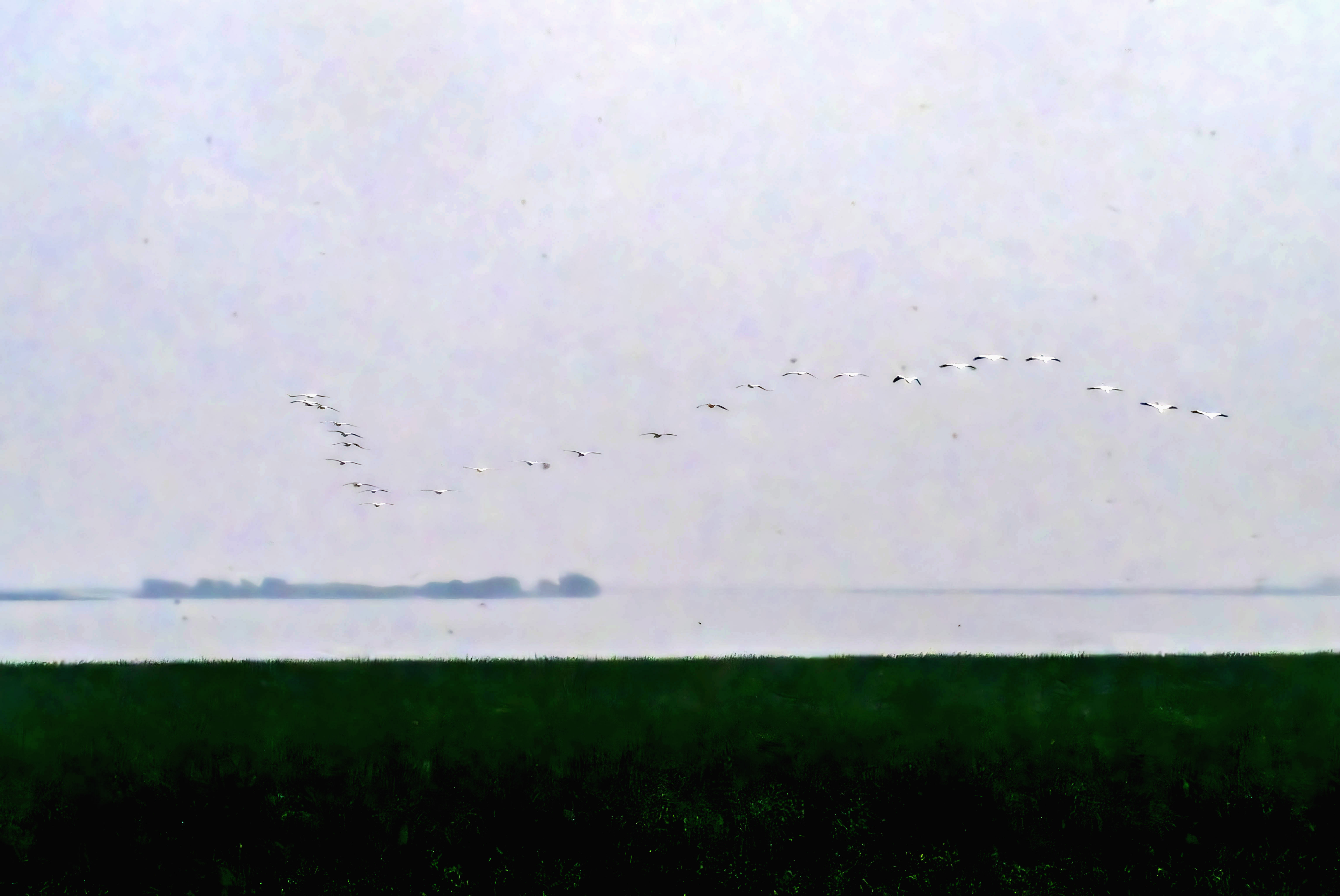
Grace … when poetry of nature blesses you with a memorable moment …

I still find magic in the prairie, in the skies, the timberlands, the BWCA, the mountains and in those sweeping landscapes all around. I find joy in the wild beings, in an unexpected flush of birds over a prairie meadow, or a poetic surprise of birds suddenly appearing in an otherwise mundane landscape; the immense poetry of trees, of their hefty, spreading limbs, of how a single tree within a forest can portray such stark individualism, of how the symmetry of autumn leaves can bring a smile; plus the wonder of the beyond, be it a breathtaking full moon coursing light across water or a sea of prairie grass, or offering a special moment to silhouette a crane or heron, or the fluid aerial ballet of an Aurora Borealis offering graceful waves of heavenly beauty; or even that of my dog, Joe Pye, ambling through our tall grass prairie at Roberta’s side sniffing at mysteries I’ll shall never know, of his pure excitement of simply being alive and free.

Yes, alive and free, of an ability to create and hopefully capture beauty that so long ago was basically erased from our collective consciousness. Hopefully in my aging I’ll continue to embrace those joys of capturing natural poetry more so than in my seeking some sense of personal grace. My fear is if I don’t note that discovery of natural poetry with my art that I will no longer find joy or the magic in life. Without that magic and joy, what would be the point? What else would I do?
In Pursuit of a Dream

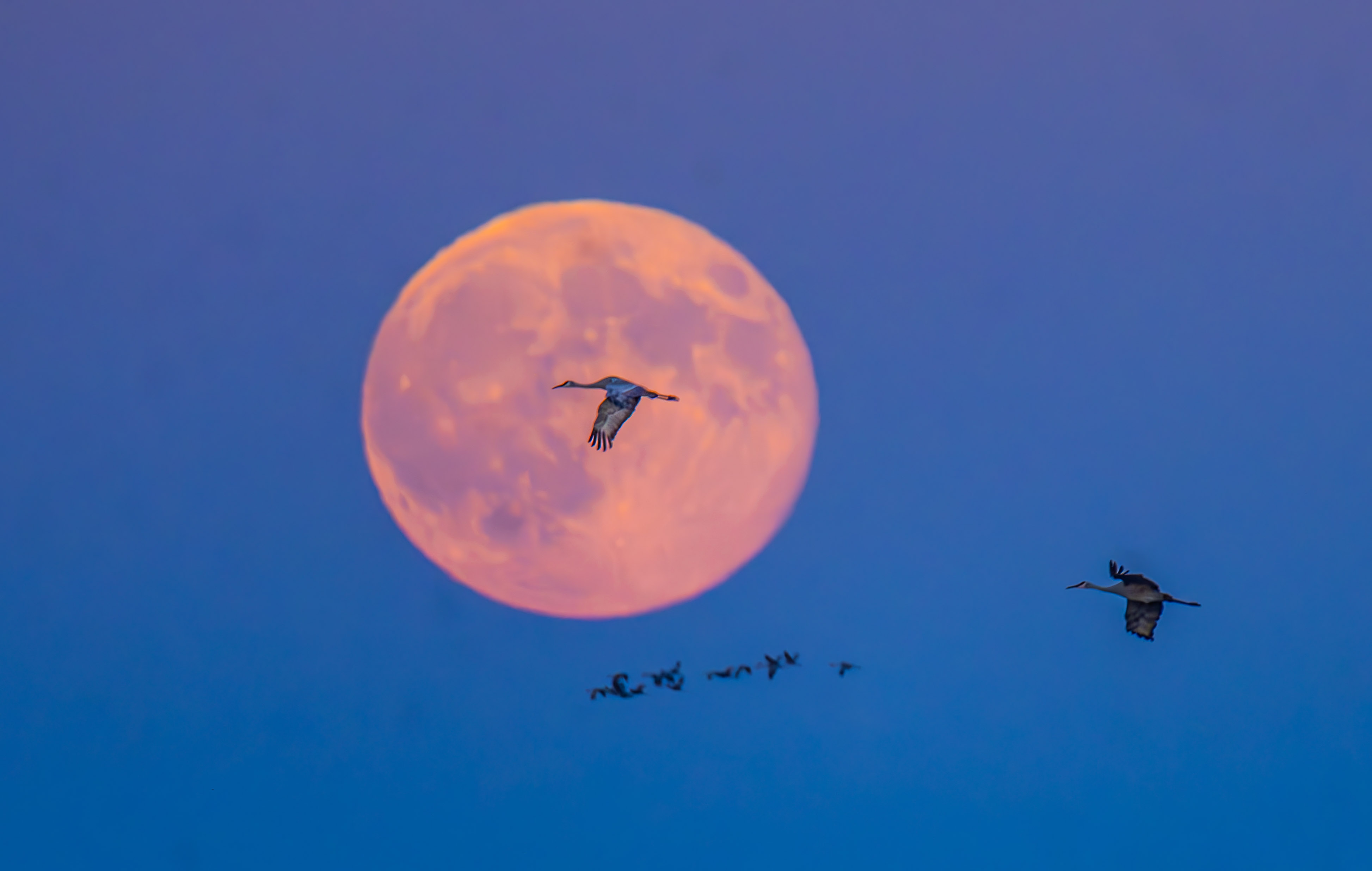
My dreams and visualizations of capturing my beloved sandhill cranes, birds of such poetic flight and stoic stance, silhouetted within the glow of a beautiful full moon have been craved for years. Cravings that caved, especially along the Platte River in central Nebraska years ago when “uncooperative” cranes simply avoided a full moon high in the sky. This, I hoped, would be different.

When forecasts of a full moon were made a lovely Wisconsin marshland refuge beckoned. I was hopeful of having a large globe rising from the horizon, blazing with color … something quite different than that moment in Nebraska … with the cranes cruising through. Hope resonated from the colorful moon names all heard within moments of our arrival …   “Super” moon, “Harvest” moon and “Beaver” moon. Native American lore provides even more mental possibilities, dangling the names of a Whitefish Moon, Deer Rutting Moon and even Frost Moon for the November lunar show. How about a “Sandhill Crane Moon?” That, at least, was my hope.

With luck a beautiful glow and globe of a moon would appear on a clear night, and since we had free time, we meandered across the state to Crex Meadow Wildlife Area just across a paved road from Grantsburg, WI. This would be a sunset/sunrise affair, prime times for sandhill crane activity unless you opt for mundane images of grain field gatherings. 

Thousands of cranes traditionally stop at this 2,400 acre marshy refuge where each autumn they congregate for pre-migration safety they find within the numerous and large wetlands surrounded by miles of dike roads as they stock up for their long flight. 

Certainly there were cautionary concerns on our four hour drive, for Grantsburg and Crex Meadows is as close to the Eastern Minnesota border as we are at Listening Stones to South Dakota. My concern? Clouds. Be it eclipses, Northern Lights, comets and numerous attempts of photographing the Milky Way, cloud cover has been a lifelong photographic nemisis. Still, I made hotel reservations and convinced a neighbor to mind Joe Pye overnight so we might fulfill my dream of capturing the cranes cruising through a rising, neon bright “supermoon.” What was there to lose except time and money? 

Then something entirely unexpected occurred. After spotting a couple of singular cranes as the “golden hour” light descended upon us, I pushed the review button to check on the color, light, composition and selective focus to discover a totally blank review screen. Yes there was momentary panic. All the visible and magical buttons were pushed on the camera body. To no avail. 

We began by working a large “flowage” along the Main Dike Road where I’ve previosely captured successful images. As the golden hour light began to bask we had seen only a few cranes. Yes, an attendent in the main headquarters had suggested this as a possible location for capturing the rising moon. When you have but one chance on capturing a dream, nervousness settles in. Quickly a move was made to the nearby “Phantom Flowage” where we found an excellent, unobstructed view of the eastern horizon. Our wait for cranes was short as they began returning from the nearby stubble fields.

Since it sounded like the shutter was working I continued to focus and shoot. Memories of all those years of shooting film without instant review came to mind. Apparently I’m now fully immersed in the digital age and long past those long ago travels to many of the lower 48 states for magazine stories and corporate assignments, back when there was a certain confidence that my images were securely captured and saved on rolls of Kodachrome or Tri-X, that in the developing the creativity would magically appear. Would it again? Regardless, I would be “shootiing blind.”

Magically the upper crescent rim of the moon suddenly broke on the distant horizon and it slowly rose higher into a lush fullness. A moment of awe struck even without my loveable cranes. I was still hopefully pushing the review button. Mental notations were made to remind myself to keep the faith, that I had been in this situation hundreds of times back in my career days. 

Initially distant flocks crossed in front of the moon, and thoughts were made to capture various images just in case I might convince my artist friend, Joyce Meyer, to sandwich if I couldn’t fulfill my visualizations. Over the years she has made about a half dozen “sandwiches” for me due to my ignorance of post production technology.

In the midst of those thoughts a few cranes began flying much closer to us to land just a few hundred yards across the marsh. With no way of knowing if any had been captured silhouetted against the incredibly beautiful “supermoon”, I continued to keep shooting until complete darkness had settled in. 

About an hour before sunrise we returned to the muskrat lodge to await any early activity. As I stood outside the car waiting for light and bird movement, those “trumpets from the orchestra of evolution,” as Aldo Leopold poetically described their haunting calls, began in earnest. Within moments I was surrounded with an unforgettable experience of sound. From either side of the graveled road, and from above as a nearly invisible flocks flew over. This was truly a moment of auditory heaven.

Eventually morning broke and I could easily capture cranes landing near enough for some nice photographs. In time, though, the curtains closed as the cranes, little by little, flock by flock, lifted from the marshlands to head toward the stalk fields. After a breakfast of hearty pancakes we made the four hour drive back home to the prairie where we were greeted by an anxious dog and a deafening quiet away from those syncopated sounds from the marshes. 

After a few friendly pets I rushed to the computer to insert the card and was graciosly greeted by cranes bathed in golden light and far more images than I would have ever taken had the camera monitor worked. Eventually I worked my way through some 800 images, or about 29 and a half rolls of Kodachrome, a tedious process that produced 80-some keepers that included many of sandhills silhouetted against that gorgeous supermoon. Dreams granted many times over!

Afterglows

Sometimes a colloquialism may come back to bless you, something I’ve been thinking about for a few days of receiving some of those blessings. First, with apologies, the back story:

Denver was the destination of a special 4-H award a few years before I was old enough to drive. Some 17 years or so later Denver was my destination after leaving a comfortable and supportive managing editor with the Dubuque Telegraph-Herald. An interesting tie between the two dailies was a fellow named Monk Tyson, who was nearing retirement with the Post.

As I traveled through the towns along the Mississippi River, and into the depths of the wooded hills of the Driftless on both sides of the river, from Galena to Prairie du Chien and places inbetween, many of the older people I met and interviewed for stories kept mentioning Monk’s name. We apparently covered the same beat at least a generation or so apart.

My blessing this past Sunday …

When I arrived in Denver for the second time I was initially given a freelance assignment by the ME John Rogers for the Post under none other than Monk Tyson. Yes, I finally would  meet the person behind an old and storied legend back in River County. Less than a week into that assignment I was called back to Denver and offered a full time position. Months later Tyson would have a massive heart attack in the parking lot across the street from the newspaper. A week or so later my assignment was changed. I would replace Monk as the “state side” reporter, meaning I had left the Driftless for the Rocky Mountains to continue working a familiar job.

Then on Monday this happened, initially seen while cooking dinner …

Eventually we would create a column called Country Roads that packaged a typically full page layout of my photojournalistic efforts along with a story. That meant I was spending most of my time outside of the office and Denver, rolling from town to town, hooking up with ranchers and even wine makers, farmers and lonesome High Plains characters with stories to tell. Everyone, as feature writer’s learn, has a story. 

Often in my trunk was a fly rod, a box of trout flies and a kite, the latter of which I loved to sneak onto some remote mountain cliff after work where I could play with the winds in a full 360 degrees of sky and unpredictable winds. Again, after work! After an interview in those mountainous climes I would ask for either a cliff or trout stream. In the Plains, a good steakhouse!

Often times I receive a little help from my friends, the birds!

This was a time I when learned the meaning of a new colloquial phrase common to the people among the mountains. “Afterglow.” You might be having an early breakfast in a small town cafe when you would overhear someone say, “Wow, did you catch the afterglow last night?” Their meaning finally dawned on me, for you see, there is rarely a place where you can actually catch a true sunset because of the mountains, yet the ambient colors from a lowering sun would paint the top of the peaks and those towering clouds, especially those to the east, with amazing colors. For those it wasn’t about sunsets but the afterglows.

Nowadays, living in my weird sense of retirement, sunrises from my deck or sunsets through the huge plate glass kitchen window while cooking dinner are rather common. Afterwards comes the afterglows that will often fill the cloudy prairie skies with incredible colors. Rarely taken for granted, and always appreciated, it is as the late professor, dean and essayist Bill Holm would suggest, “A horizontal grandeur!” 

Back in May, above the Big Stone Moraine …

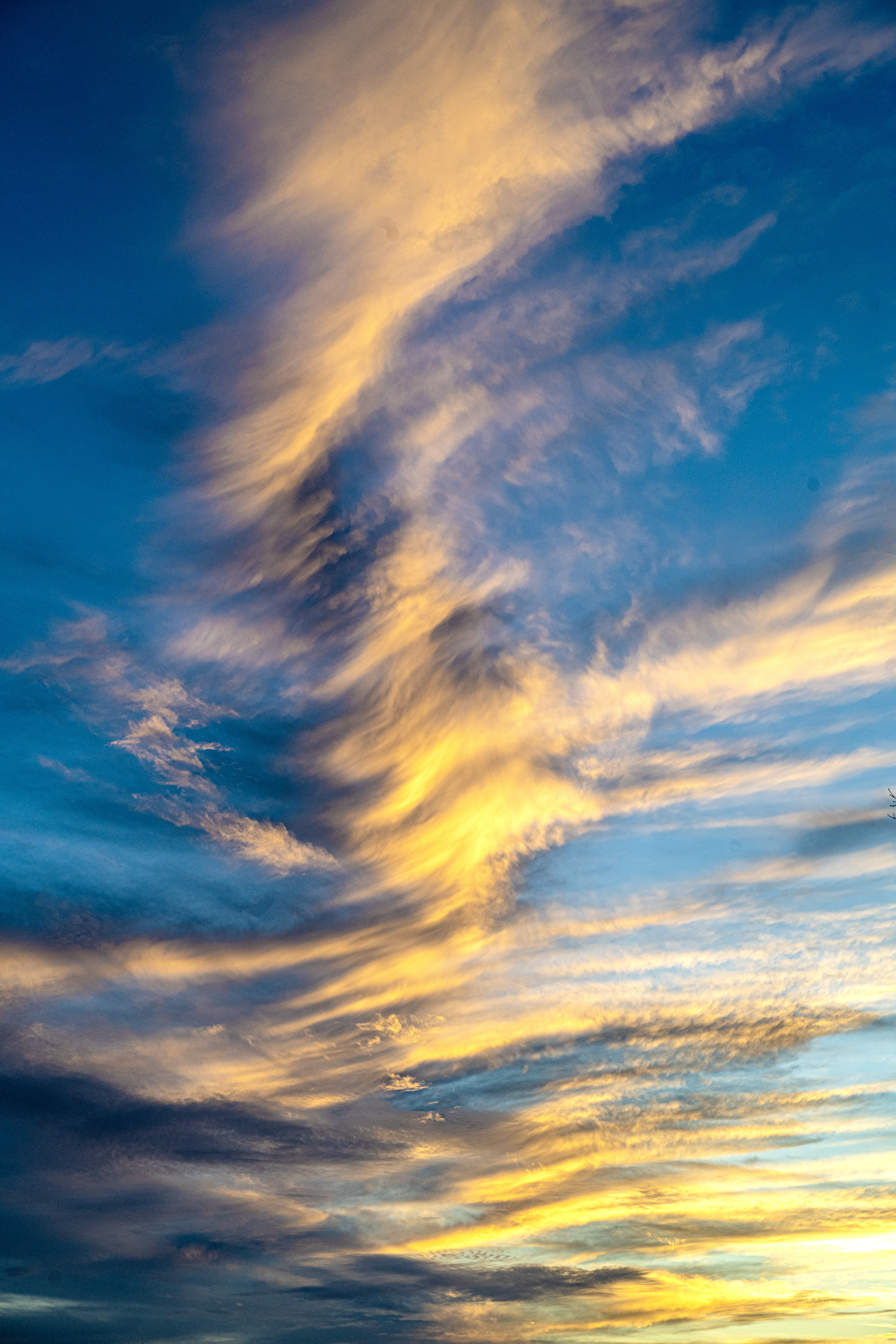
Frankly, for me at least, sunrises are seemingly more “grandeur” than those late afternoon sunsets. Oh, but the afterglows! Yes, Colorado and the other mountainous states have those moments when the afterglows are stunning, although I might suggest that the prairie skies are far from a shrinking violet as ambient colors create vistas as stunning as any view you might visualize in the mountains. Yes, they’re such a blessing!

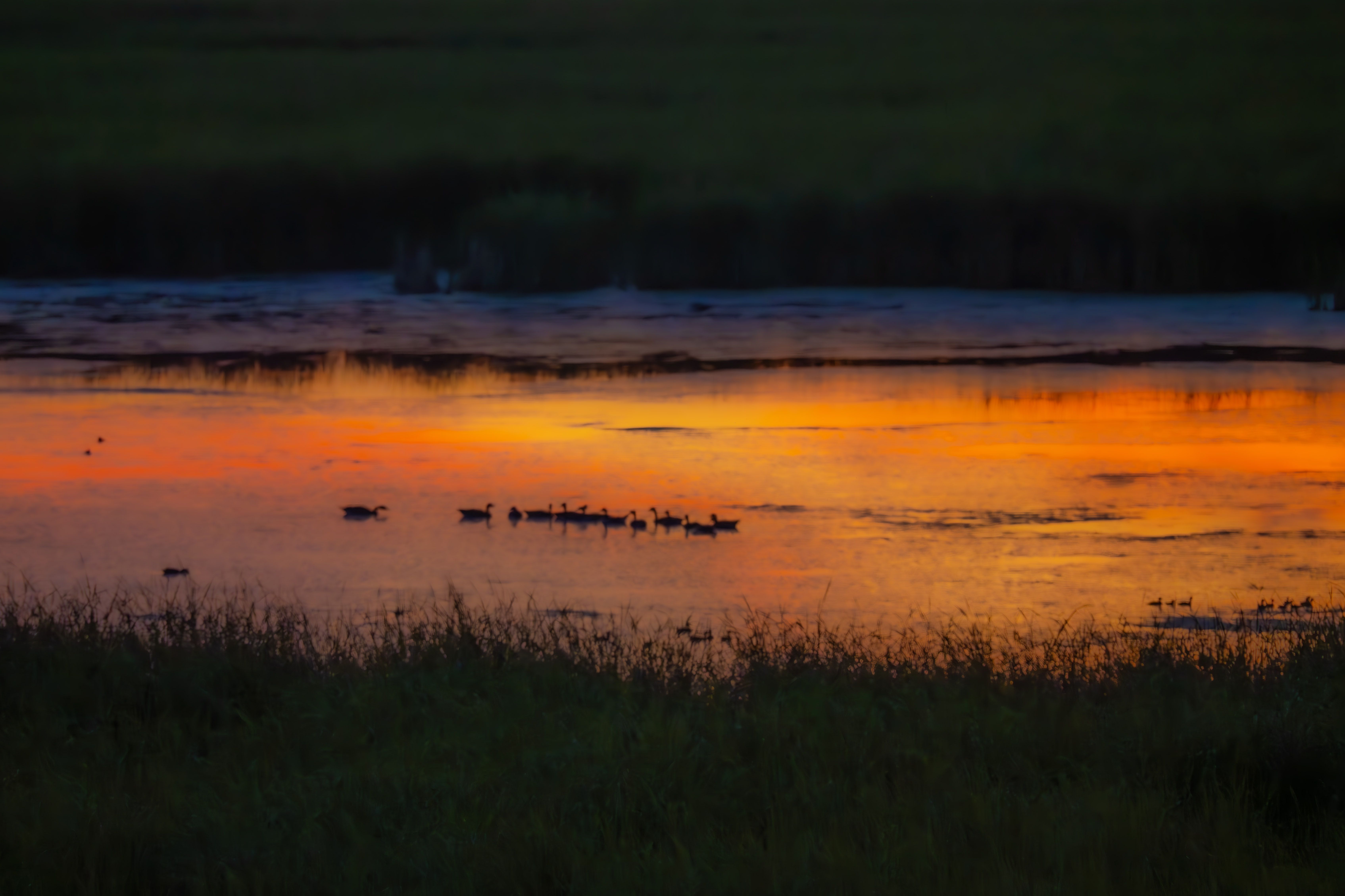
And I almost always look eastward away from a setting sun in search of clouds and ambient colors, of softened light, of how it might blend with what a young friend calls the “rainbow sky along the horizon.” Sometimes the reflections in the wetlands adds another entirely beautiful spectrum to an image, and when you can add the turkey feet of the Big Bluestem, there is no question that you’re in a nice patch of prairie. 

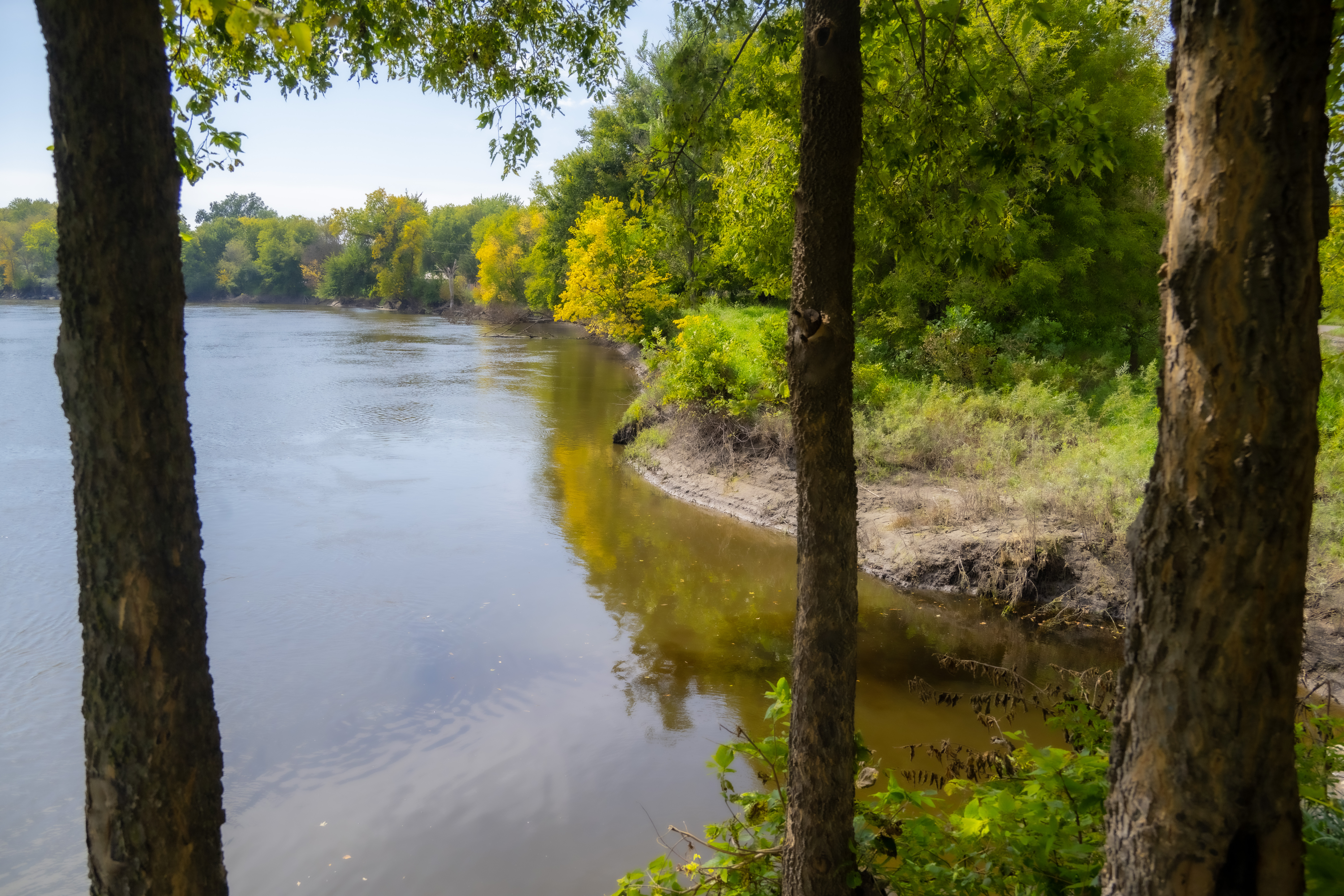
And, when reflected in waters, this the Minnesota River, the pleasures are immense …

I have nothing against mountains, yet as Holm suggested, the vastness of a prairie sky can be just as humbling as it is magnificent. When those colors paint the clouds I’m often in awe. This reminder came to me again earlier this week with two incredible afterglows I was able to capture. 

Now in a more reflective period of my life, so many memories have a way of sneaking into my consciousness. Those times along the Mississippi, and those in the Plains and mountains of Colorado, offer strong moments of a wonderful past. Sometimes those moments are visual, and happen after the sun has lowered beneath the rim of the horizon and a pallet of ambient colors paint the clouds up above. No two, it seems, are ever alike, and in their own way, each individually, offers a unique vista. So thanks to all those folks in the mountains for what was then a new word, and still a reminder that sometimes the light after a sunset is often the most beautiful of all.

Along the River

Initially I didn’t realize I needed a river. We were simply on a lazy afternoon drive with only one commitment. Yet, there seemed to be a calling, one apparently buried deeply in subconsciousness.

Yet, here we were. For thirty some years my “home river” was the Minnesota, from the headwaters at the foot of Big Stone Lake down to Mankato where it takes a serious bend to head northeasterly toward its confluence with what becomes the Mighty Mississippi. Hundreds of gneiss outcrops line the shores of the upper river, and eagles often man the riverine forestial  corridor. It’s a river that if one was blind to the murky waters it might suggest resemblance to the BWCA.

With a little time to kill before meeting up with an old friend in Granite Falls on Saturday, my car somehow ventured toward some of my old river haunts downriver, specifically to nearby Kinney’s Landing.

There would be no tag with this heron, who flew across the river away from us.

It was auspicious start for the picturesque access where we had launched our canoes so many times over so many of those years was both empty and appeared in disregard. Part of that is undoubtedly due to a summer of high water that prevented meeting up with my old fishing buddies for a bit of walleye and catfish angling. Floating the currents over many of those years to ease behind a dead fall to drop a baited hook has continued even though I have moved from the “upper” portion of the river to the headwaters an hour or so north by auto. Many overnight gravel bar camping trips happened along these waters with huge driftwood bonfires, lines on salt water rods set for all night flathead fishing while I typically did the honors of frying freshly caught catfish served with wine kept chilled in a cooler. Hey, we knew how to live.

Yes, I miss those times.

On this day the arched “church” of a tree way canopy overshadowed ample parking spaces I remembered being full so many times, and the landing itself was mired in a thick cake of mud. An old photo of the access captured on a foggy morning years ago graces my wall, a portrayal both charming and welcoming, a place where you might sit for awhile to take in the surroundings, to sniff the air and listen for feathery songs from the leafy canopy. On an otherwise warm autumn afternoon that would have been prime, such poetry was absent. 

Leaves are just beginning to turn …

After several minutes we left to take a riverine gravel that hugs the “west” bank where we played tag with a Great Blue Heron, that quickly grew tired of us and angled across the river. The heron would basically be the only bird life we would encounter until we were near the headwaters hours later, where distant swallows livened a beautiful sunset. Yet, this was a familiar stretch, a length of river my writer and fishing buddy, Tom Cherveny, and I launched to paddle upstream to the Minnesota Falls Dam, which has since been removed. 

Before the dam removal the river spread almost lake-like to create numerous islands between downtown Granite and the dam. Just below the dam we caught stringers of nice catfish. When we paddled up to the dam from Kinney’s we would ease our way back, dropping lines along the deeper holes on the east bank and below a couple of river islands. Our heron had landed just downriver of the bigger of the two tree-blessed, rocky islands.

Now, at my age, standing on the bank and gazing at the murky waters, many fond memories of those trips came to mind. Moments that brought a smile, and a calmness that has seemed to be missing of late.

We caught the sunset at a bridge just west of Odessa.

Eventually, though, we headed toward Granite where a hydro dam still exists at the apex of this small, old artistic river town. Surprisingly there were no pelicans. Roberta, my dear partner, has expressed wonder about the sudden absence of the birds especially here in our home prairie. “I think we’re going to have a bad winter,” she’ll say. Perhaps, for on some of the prairie wetlands swans that typically have a couple of signets seemed to have hatched a half dozen or more this summer.

And, it seems as if one day our robust skies populated by two oriel species, brown thrashers, a brave catbird, Red Breasted Grosbeaks, umpteen swallows and even starlings became suddenly and eerily quiet. And, empty. Now? Sparrows and a few gold finches, slowly molting into their winter colors, fight squirrels for feeder space.

As we gazed at the rush of waters below the Granite dam she asked, “Are we following the river all the way home?” Well, yes, for you pretty much do, although you’ll cross the Chippewa, the Sag and the Pomme de Terre en route. We live here in a vast river valley, one created by the Glacial River Warren in whose abandoned bed now flows the minuscule Minnesota — by glacial standards. 

Hours later, when we reached the vast expanse of the Refuge, though, we were actually back to the banks of our namesake flowage. By then the sun had lowered in the western sky, and we had ample clouds to create some beautiful ambient post sunset color. What a blessing to behold, from the river view on the edge of Odessa and into the Refuge itself, where we found reflected colorful skies in windless waters. Being along the river was actually an unexpected blessing, although one that was thoroughly needed. At least subconsciously.

A fitting conclusion to a beautiful “river day!”

You see, I fear our times, of our loss of compassion and caring for others. It seems increasingly difficult to know the feelings of old friends who are revealing personal thoughts so different than you believed we collectively shared. So on an afternoon of what I later realized was an internal discord, I came to realize just how much I needed a river. My river. A river so mistreated with siltation and chemical runoff, yet one that has followed the same channel since the breakthrough of Lake Agassiz some 10,000 years ago, waters that just keeps ambling along, sandpapering sad thoughts and sending the chaff off along in the down river currents. 

Then there was a heron, perched in the shallows, a dark crown over its grayish blueness, and there was a flow that sometimes in less flooded times offers ripples through shallows for a sense of calmness. And now on an autumn afternoon the wooded riverine banks are taking on a magical transformation of color, and on this, an evening with troublesome anxieties, when the skies came alive with such an amazing palate of color … these are times when little feels better than the comfort of being along the river.

Doug Pederson’s Legacy of Wood and Art

As a sawmill guy, wood artist Doug Pederson perhaps felt a tinge of financial joy whenever he saw me saunter through the door of his “Doug Cave” studio on the hill above Montevideo. He and other sawmill guys, and even the floor help at those box store lumberyard joints like Menards, might have sighed in relief. I’m the fellow who painstakingly looks through an entire stack of lumber before happily walking out with a board or plank that no one else would ever consider buying, character boards with odd knots and groovy grain, nicks and knocks and varying natural colors.

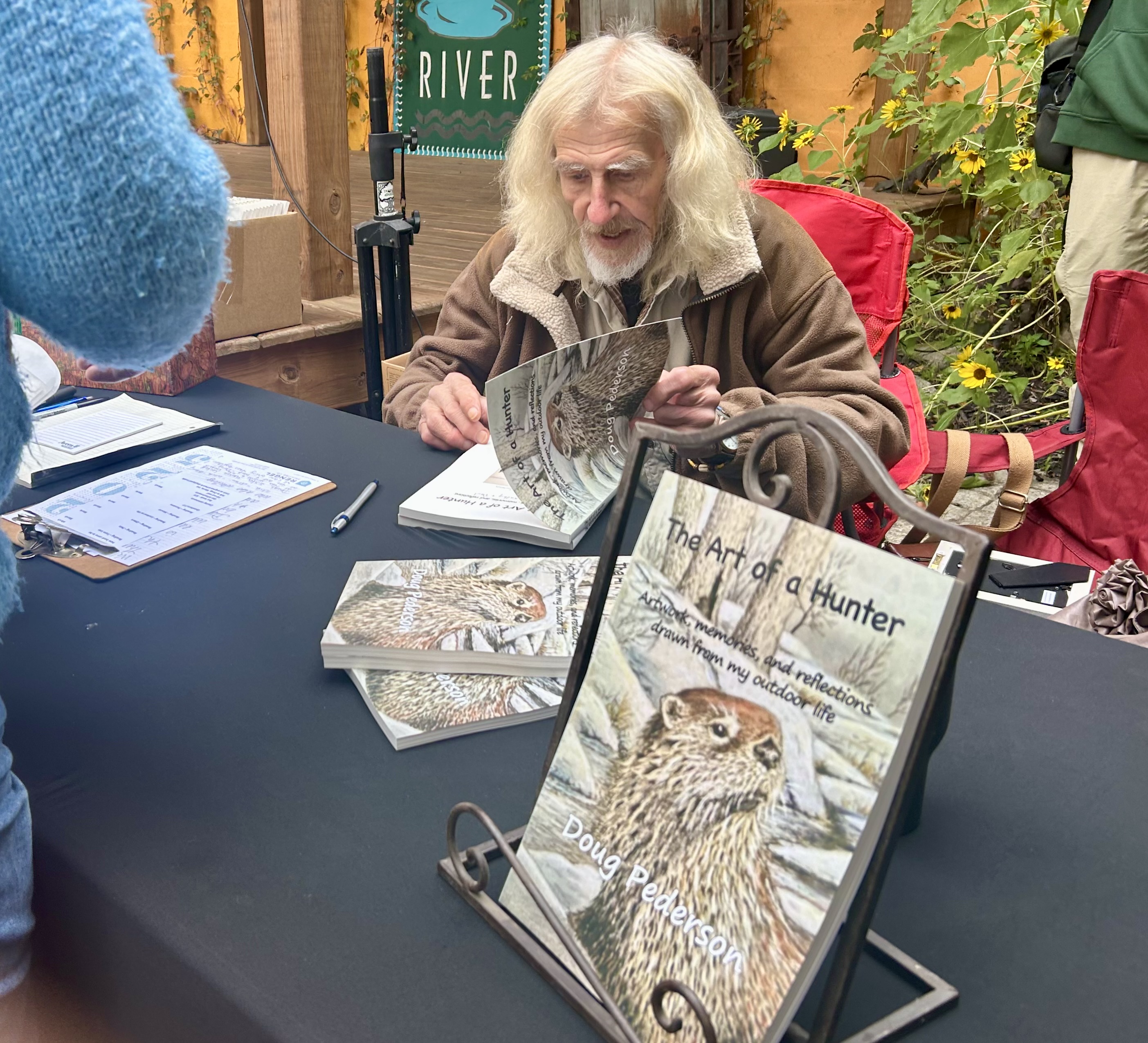
Pederson, who spent his Saturday morning signing copies of his newly published book of wildlife art and written thoughts in the courtyard of Java River, sold me a couple of “orphan” boards, and made at least another one into an incredible painting.

The back story: Several years ago an “ill-advised” couple talked me into building them a dining room table, so I called Don Schuck, a sawmill guy and wood artist up by Paynesville, to ask what he might have available. “Depends on what you want,” he said before suggesting he had some very nice maple that might work. 

With a free day my friend and I drove up and she thoroughly loved the grain and feel of the maple so that was a go. Don, though, had another board set aside knowing I was coming. He’s just that way. Besides having an incredible grain and color, it was also a wood that showed signs of chaffing. “Five bucks, and there isn’t another one like it you’ll find anywhere,” he said with the wiry, and perhaps, knowing smile.

Seated beside a copy of his new book, artist Doug Pederson signs a copy for a friend.

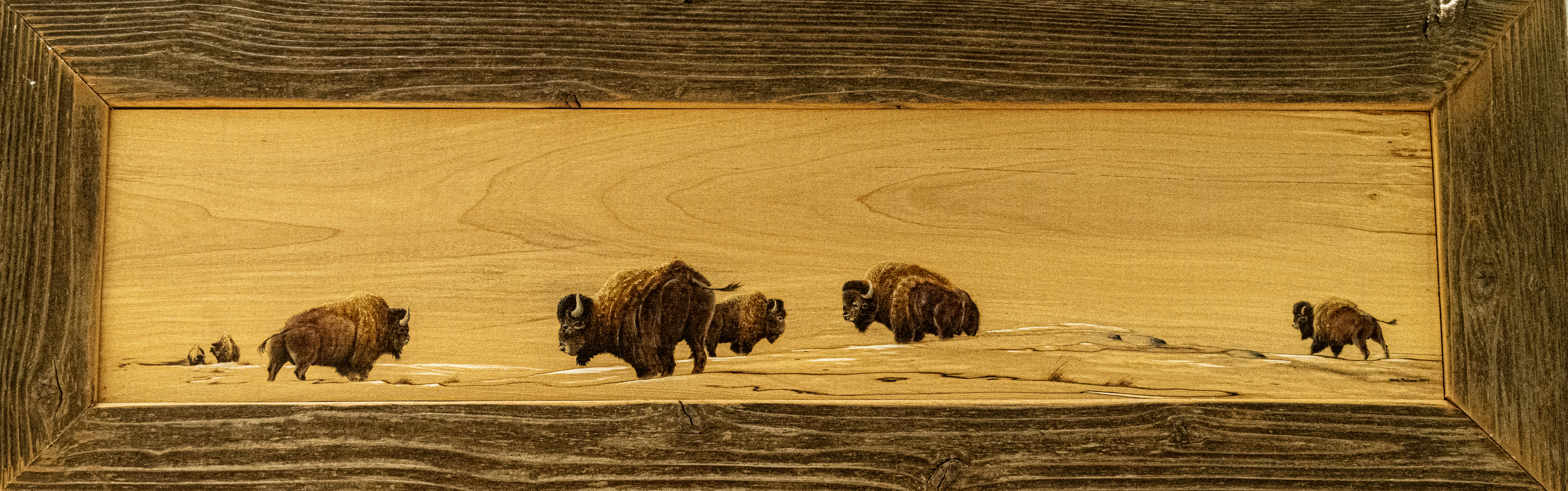
While starting to turn the maple this way and that … a key board with a dark wave resembling a flying crane would become the centerpiece … my orphan board was set aside. While intriguing, it seemed a bit short for doing much with it. One day coming in from the studio I passed this incredible board art painted by Pederson a few years before, a painting of bison where he blended the grain of the wood for the basis of a prairie mound. This is a fine example of his wood art and realistic wildlife paintings. This was a purchase either prior to or during an earlier Upper Minnesota River Arts Meander, an event he participated in from the beginning. 

After passing the bison painting the orphan was quickly placed in the pickup and we were off to Pederson’s studio where I waltzed in and handed the six-foot plank over to him. “I don’t care what you paint, Doug. And there is no deadline. Stick it someplace and see what comes to mind.”

And, I forgot about it. Literally.

Months later, perhaps years later, he called. Said he had finished a painting. That if I didn’t like it he’d come up with something different. After arriving at his studio he presented me with the orphan framed with an incredible scene of common and hooded mergansers frolicking in a rocky rapids, using the grain as waves, all framed by a branched and weathered river sprout fighting against the midstream current. A minnow is in the beak of one of the mergansers. Besides being so realistic and amazingly artistic, it was a Doug Pederson through and through. How could you not be impressed with his artistry, his magic with a brush and his keen respect of the wood grain there as a natural feature within the art?

Years ago I purchased this painting of bison where he used the natural wood grain to accent a prairie mound. His use of grain is a beautiful feature of his paintings.

Oh, there was also the time upon leaving his studio on a chance visit that he had chunks of scrap slabs in a battered cardboard box by the outside door. I picked one that possessed a lot of character, a thick piece of weathered walnut. Paid him a couple of bucks before handing it back with the same request. “Here, Doug. Paint me something.” A couple of months later he called. On the darkened slab of walnut he had painted pair of otters peaking around a debit in the wood he used as a stream-side stump. He had sliced the slab in two, using part for a base to anchor the half with the painting. A cool shimmering of bark with a perfectly placed knot surrounding the base pulled the whole piece together. Pure magic! Amazing artistry!

All of this along with a couple of spalted maple vases with wildlife portrayals came to mind as I pulled into the only parking space available within two and a half blocks on either side of the street for his signing of his newly published book, “The Art of a Hunter.” This was a book signing I couldn’t miss, not after all these years of visiting Doug in his studio, of hanging his paintings, and not after learning earlier this spring when his son, Brook, after he called for me to pick up some walnut lumber he had milled, told me that his father had some serious health issues. Too many years of unmasked breathing of fine wood dust and a horrible smoking habit.

Using mergansers and a wood sprout in the current, all in connection with the natural grain, turned this “orphan” board into a beautiful pies of art.

Despite a very chilly early September morning, the courtyard outside of Java River was standing room only. All the courtyard tables were filled with folks crowding along the side. Out on the sidewalk beyond the wrought iron fence they stood about two deep. Doug’s wife, Marie, who manned the shelves of the local library for years, and his sister, Marcia Neely, took turns reading excerpts as Doug patiently signed book after book as the line of patient friends and fans of his art continued to wade up to his table. He knew us all.

His book is a fine collection of his years of painting the prairie nature he so loves, and his many thoughts of man’s dealing with the creatures of nature, those hunted and those he lovingly observed over a lifetime as a prairie naturalist and artist. Just inside the cover are these words: “I have a hard time using the word nature as if it’s separate from humans. We are one and the same but we humans seem a little lost.”

Marie and Marcia talked about the processes this semi-reclusive artist and woodsman went through, collecting and creating the paintings included in the book before his sister told of how her now elderly and struggling brother suddenly became quite energized once he began writing the text. Perhaps it was a life enhancing experience. With help of a grant from the Southwest Minnesota Arts Council (SMAC), he and his family began curating the art and putting the text together in what became a 116 page collection. 

A walnut slab found in a cardboard box by his studio door was converted into a nice piece, with a pair of otters peeking around a flaw he used as a stump in the painting.

“Some of my best experiences happened while sitting in the woods or on the water with a camera,” he wrote. “I called it ‘catch and release’ hunting.” Something I have been doing for years, and like my long time friend, my outdoorsy-ness is more observing nowadays with my camera rather than actually paddling and fly fishing.

Times move along and there is no longer a “Doug Cave” on the hill just outside of Montevideo. Brook remodeled his and his father’s old wood shop studio a year or so ago to convert it into an Airbnb. For years Brook continued to work the family’s tree trimming business where much of the wood he and his father used for their respective art was cultivated. As times moved along, Brook no longer maintains the old family business. And his father? He just published a book on his life as a naturalist and artist, a fine reflection of his legacy of wood and art.

If interested, copies are $25 apiece and can be purchased at either Java River or by contacting Doug at scrimdp50@gmail.com/.

Prairie Harmony

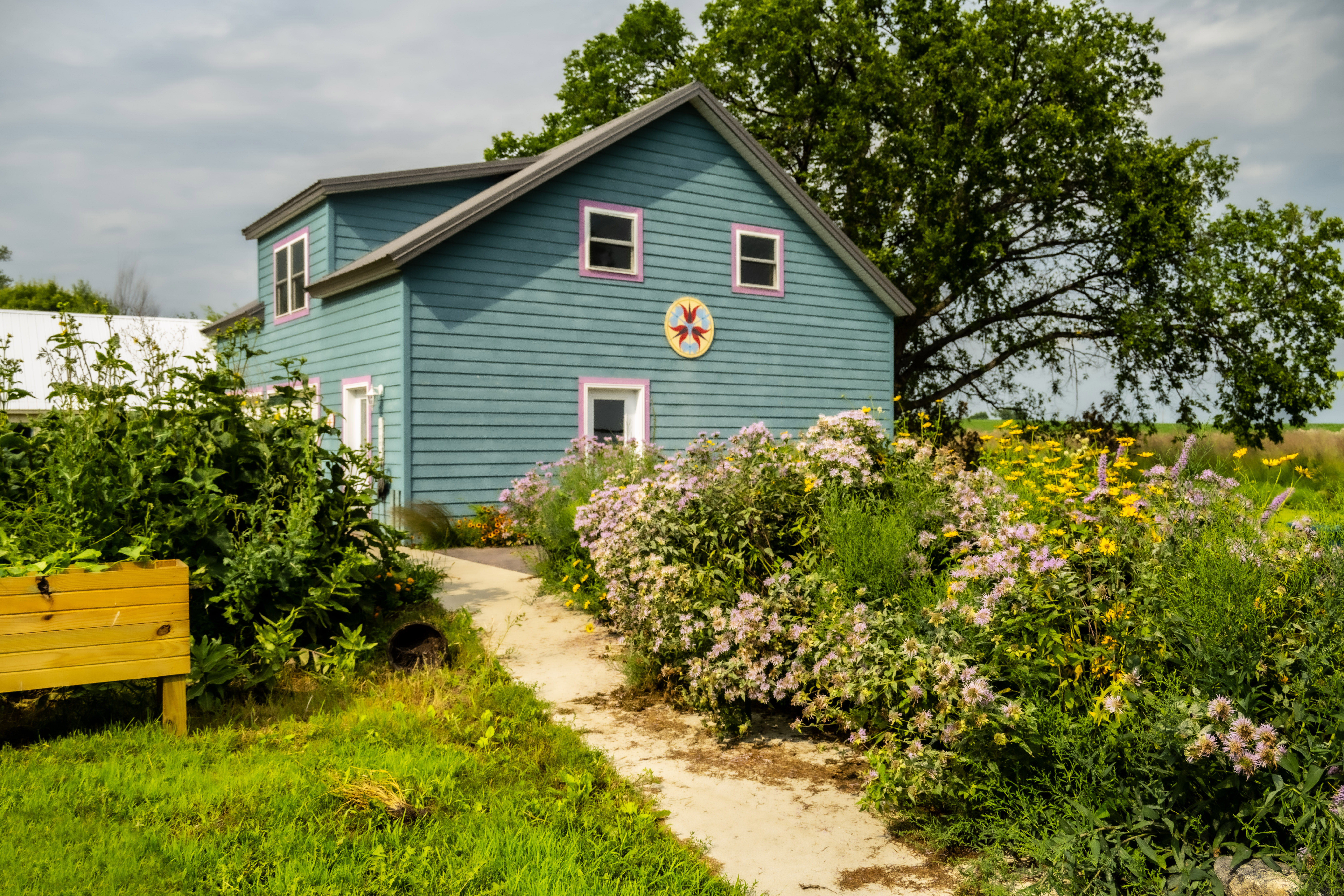
A delightful hum is providing us new music here at Listening Stones Farm. It comes from near a sidewalk from four years ago, and it comes from a native prairie garden we created beside the sidewalk a year ago. Across the adjacent patio are a pair of “strip” gardens of native plants where “blanket” flowers have created a mid-summer dominance, Across the patio is our “triangle” prairie garden where compass plants have for years bullied their way to crowd out nearly everything else. Tall and rising from the square stems are the yellow blossoms.

Bees and other pollinators have come in droves to feast on the multitudes of pollen from these plantings. Before all of this color and blissful natural harmony our lawn, a boring landscaped carpet of green covered our yard. We would have a few weeks of sparkling yellow dandelions dotted with bees. That was about it other than our nearby prairie restoration.

Initially elusive, the yellow swallowtail eventually allowed some photographic moments!

Adding to these gardens are a couple of shaded pollinator plantings alongside the house where in the past we would have had an early flush of beautiful red columbines. Initially these native plants hugged the north side of the house, then I took a spade and transplanted a few inside a little space existing inside an ancient sidewalk someone years ago laid into the soil next to our solarium. I don’t know how far the sidewalk extends. When planting the shade-friendly prairie plants we purchased from the Lac qui Parle SWCD last summer I realized a lot of the sidewalk was buried beneath the lawn, and that the concrete walkway reached at least to where our rooted horseradish dominates.

We also have our terrace garden that stretches along the west side of the house that faces the county road. Huge granite boulders were plugged into the landscaped rise where various prairie natives were planted in a narrow nook of exposed soil that is separated from the lawn with landscape fabric. Like a prairie, every year is different, and like the other plantings, weeding is constant chore.

A pair of monarchs tantalized before landing near one another.

So we have bees and other buzzing pollinators completely surrounding our home. That’s the music we hear. A hum of a natural orchestra highlighted by a variety of songbirds, from wrens to a pair of yellow warblers with a catbird and mourning doves adding a sense of sweet percussion.

Yet, I’ve not even mentioned the butterflies, whose flights might be inaudible to human ears. At least mine. 

Right now we have numerous monarchs flitting around that were recently joined by a beautiful Eastern tiger yellow swallowtail. It seemed the red admirals settled in first, sneaking in quietly, along with a variety of fritillary species. Other random species have been in and out, and I’ve found it difficult to keep up with all these beautiful visitors. Dainty cabbage whites, with their little dots displayed on the wings, have sneaked in as well

A view of three of the gardens … our new one to the right planted a year ago, the “triangle” to the left with the tall compass plants, and the peeking strip garden next to the studio.

So many of the native flowers are now in bloom that our eyes feast on color from yellow to white, bright orange to glittery purple, so when you add all of these flitting, flying colorful blossoms of butterfly wings with the hum created by the variety of bees, it is all a wonder to behold.

As mentioned, we also have eight acres of grassy prairie basically surrounding our home, although since a misguided though “helpful” neighbor mistakingly mowed down a post-burn incredible flush of flowering natives years ago, some of the joy is missing. Those flowering plants have never recovered. Oh to have retained all that incredible color within the mix of both cool season and warm season prairie grasses, our prairie would be a wonder. This was an unfortunate mistake that has haunted me ever since.

Red admirals were our first butterflies in our new pollinator plot.

Hopefully we aren’t done with our pollinator efforts. A house-long narrow strip of lawn exists between the house and terrace garden that is begging to be converted. This section is barely wide enough for the mower and simply looks awkward and, well, a bit naked. This has been a transformative strip for years. Initially a couple of large bushes existed beneath the kitchen window that we pulled out to make way for blueberry bushes. Those new plantings never caught hold, and it’s been barren except for lawn grasses ever since. 

Hopefully someday one of my favored native prairie plant friends will come for a visit to offer advice for selection and placement of plants for that area. My reaching out hasn’t worked so far, although I’m still hopeful. Why? One only needs to look at our newest pollinator plantings along the sidewalk to understand why. Because of my ignorance that patch is completely backwards. Huge bushy plants are so dominate along the sidewalk that many of the smaller species have been crowded out, or are hidden in the background. Anyone with knowledge of those plants would no doubt guffaw as did a carpenter who witnessed my first attempts at hanging drywall. 

While the butterflies add joyous color, the bees and other pollinators create the hum of the orchestra.

Fortunately the butterflies and bees don’t mind, even if we humans are crowded off the sidewalk en route to my art studio. Yet, there are those moments utter joy. 

Earlier this week I took a momentary break on our newly refurbished deck with a cup of cold sun tea when I noticed the swallowtail hovering over the blossoms. Over the past weekend I had noticed it and went to fetch the camera, though when I stepped off the deck with camera in hand it lifted quickly to fly in flitting defiance to parts unknown. Now it was here, painstakingly maneuvering through the blossoms. A pair of monarchs were traipsing between the various enclaves, and I caught sight of a red admiral on the closer blossoms.

This strip of lawn just above the terrace garden will hopefully be transformed into another vast prairie planting yet this late summer or fall.

So I fetched my camera. This time all of the butterflies were cooperative, including the moody swallowtail, and so were some bees. Our plants? They seem to bask in their respective glory, posing time after time. Eventually a round was made to each of the various gardens as a lovely calmness eased over me. With it came with the realization that over a short period of time we have created so much more than that springtime flush of dandelions, and that we can now count on hearing the hum of pollinator music over and over again, accented with our bevy of birds, creating a natural symphony as sweet and soothing as a Bach’s concerto.

Isn’t that what it’s all about? 

The Balm of Dawn

Initially I was rather discouraged, and perhaps “rather” isn’t quite strong enough to convey my feelings. You see, I had visualized an image for a week or so after we discovered that the beautiful meadow of cone flowers in the Big Stone National Wildlife Refuge had bloomed, long enough ago that many blossoms were already showing their age. Crinkled petals, some showing brownness on the edges of the delightful pink. In short, there wasn’t much time left to capture my idea.

My intentions were rather simple, for I’ve envisioned a simple softness of fog with the defusing warmth of a rising sun providing a bit of hazy backlight to this expansive meadow of pink. Summer fog, which happens frequently in the lowlands of the prairie, isn’t uncommon over the wetlands and prairie around dawn much like it does in the Boundary Waters, rivers and lakes. This meadow is just up the rise from the broad waters of the West Pool, which is a flooded basin managed for protection of waterfowl and other aquatic avians.

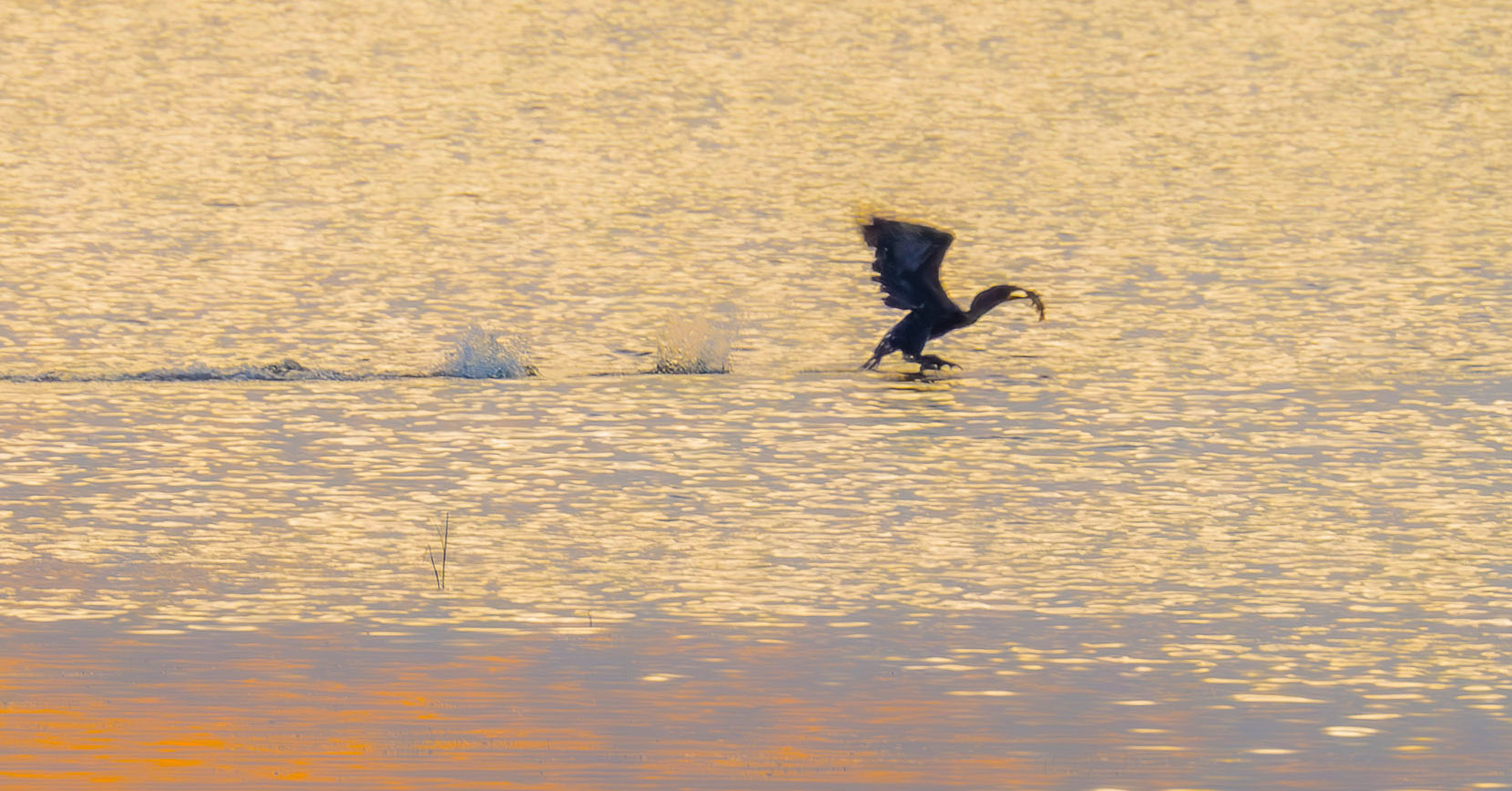
A Cormorant skips across the waters of the West Pool with a dawn breakfast in its beak.

Then, there’s this: It has been awhile since I’ve ventured out for pictures before dawn, somehow losing the habit of being up to greet what the late naturalist and photographer Edwin Way Teale called “nature’s finest balm.” Yes, dawn. Perhaps it’s an “age thing.” 

My dream of a foggy image is somewhat different since I’ve photographed these cone flowers religiously since moving to Listening Stones Farm a dozen years ago. After a scorching day the thought of a rising fog had me up and into the pickup about a half hour before sunrise. My intensions and excitement took an immediate hit because a dense cloud bank was covering the eastern sky. Since I was already up and headed to the Refuge, why turn back? 

Despite my disappointment I still eased from the truck with my trusty Nikon and wandered through the grasses and flowers making a few half-hearted images. Hardly anything worth remembering. My files are loaded with cone flowers from this meadow, including a really nice senior picture of the daughter of friends. Which wasn’t the point. My visualization was the point.

I could spend hours watching Black Terns ply the waters.

Perhaps Teale’s entire quote is worth noting: “For the mind disturbed, the still beauty of dawn is nature’s finest balm.” Taking this to heart would be my new challenge. 

After a deep breath, birds of various species were seen skimming across the still waters of the West Pool while above me Cormorants were scurrying by to their secret potholes, prehistorically shaped fishers silhouetted against the colorful, cloudy canvas of sky. Solitary Great Blue Herons made curved-neck flights across the muted skies. The skies were alive! It was then I remembered catching the gaping mouth and awkward warnings from a female Night Hawk on a distant outcrop. This didn’t have to only be about cone flowers and fog.

At the far bend of the motor trail I caught a Cormorant bounce-splashing across the surface with a small fish firmly captured in its beak. Kingbirds and a Bobolink moved across the grassy prairie trying to hide from the cameraman. Ring-billed Gulls and Black Terns provided nearly an hour of entertainment at the bend of the motor trail, playing in a nice reflected, colorful light. Terns were attempting their athletic poetry of dipping their bills into the waters as they sped across the surface. This alone can capture my attention for time on end.

Flights of White Pelicans are usually delightful to observe.

Of course, being in the refuge meant White Pelicans were around, although far fewer in numbers than the cormorants. The two fishing pals make an interesting contrast in almost all ways … color, shape and beauty of flight. They seems to ply the same spaces in search of nourishment with the Cormorants diving out of sight and the pelicans often teaming up to corner their prey. It was here at the bend of the motor trail where both frequent. Last autumn I caught hundreds of pelicans in military-like formations crossing the West Pool in murderous mayhem. Squadrons of them, numbering several across, all easing eastward across the waters. The next day there wasn’t a pelican in sight. Apparently I’d stumbled upon a last feast before migration.

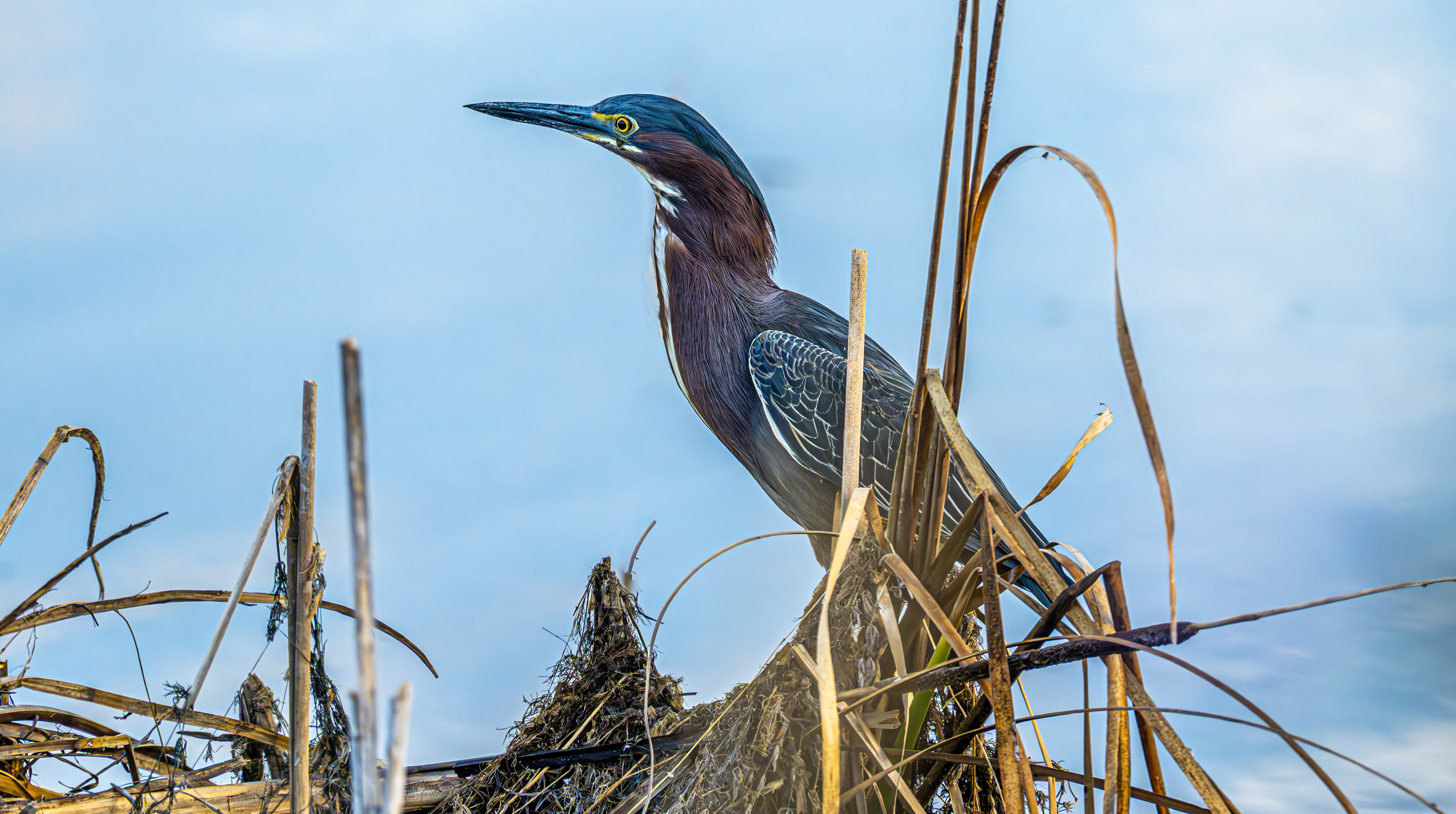
Eventually it was time to move along so I drove around the last big bend toward the riverside parking lot hopeful of catching perhaps a wood duck. This portion of the Refuge is along the debris choked Minnesota River. I would find a single Pied-Billed Grebe in a limb reflection and a Green Heron that posed beautifully for me. All that remained was that protective Night Hawk.

It’s always a joy to see a Green Heron, and usually they’re more skitterish.

This was certainly a delicate mission for you don’t want to unnecessarily rile up nature, and particularly such a rare bird. We had initially spied her over the weekend when we had stopped at a flat outcrop to show a former exchange student ball cacti and were confronted by the “hissing” female. While Night Hawks are graceful and incredibly stunning in flight, hovering high in the sky before diving at nearly breakneck speeds, on land their extremely weak legs make it a challenge to move. 

She was still there and immediately flopped across the granite to defend her well hidden nest. Hastily I made about a half dozen images while standing several feet away where I hoped not to be considered a serious threat. Although I tried to be quick and unobtrusive, I had no desire to cause her unnecessary strife and tension. 

The increasingly rare Night Hawk, awkward on land, defends her nest near the outcrop.

Thanks to the various birds, including the awkward Night Hawk, my dawn foray was delightful and successful. Teale’s “balm” had worked wonders. And since my dear mother once gifted me with his “Journey Into Summer” as a teenager, here’s one last Teale passage that perhaps summed up my feelings: “Our minds, as well as our bodies, have need of the out-of-doors. Our spirits, too, need simple things, elemental things, the sun and the wind and the rain, moonlight and starlight, sunrise and mist and mossy forest trails, the perfumes of dawn and the smell of fresh-turned earth and the ancient music of wind among the trees.” 

Amen!

That Hue of Blue

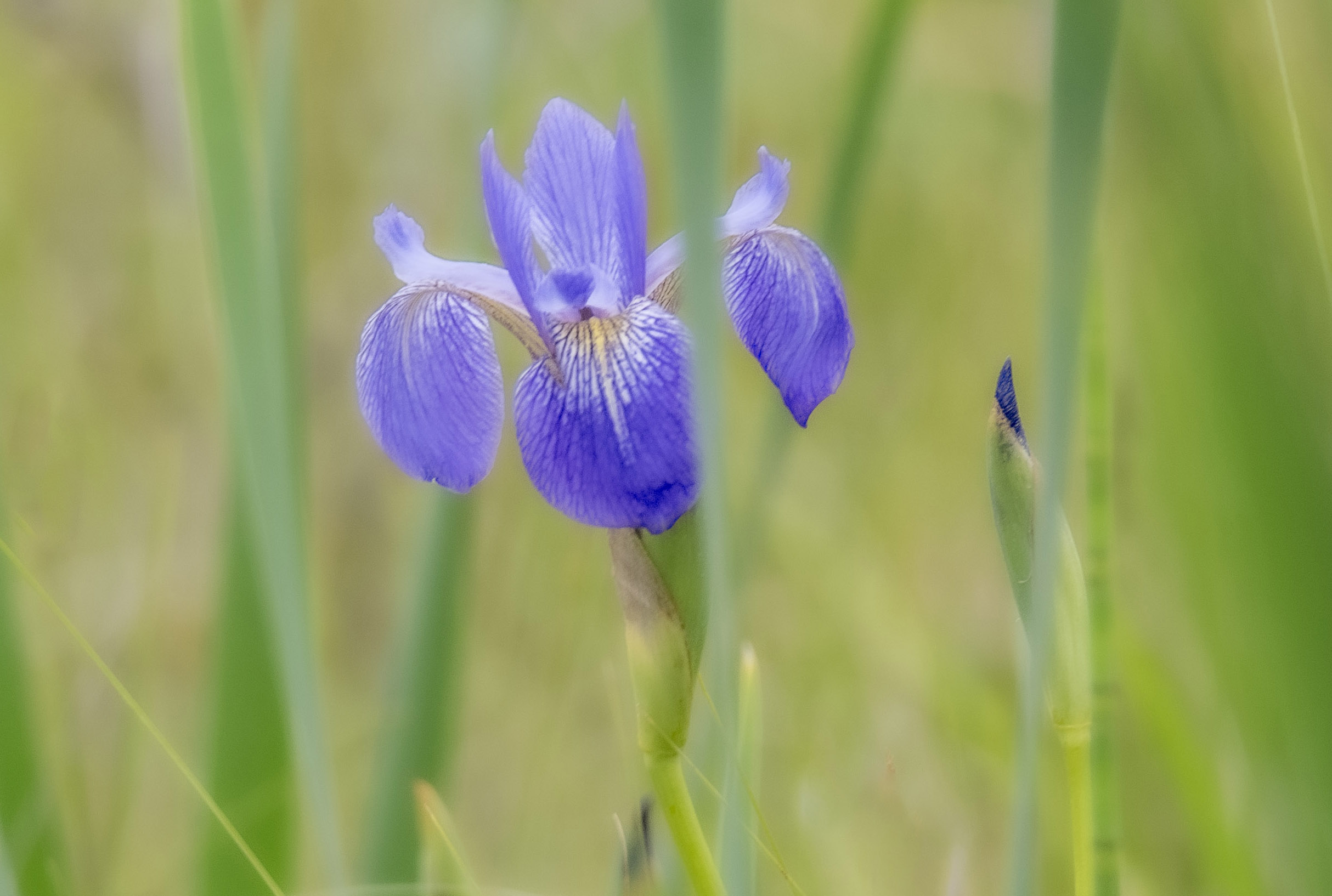
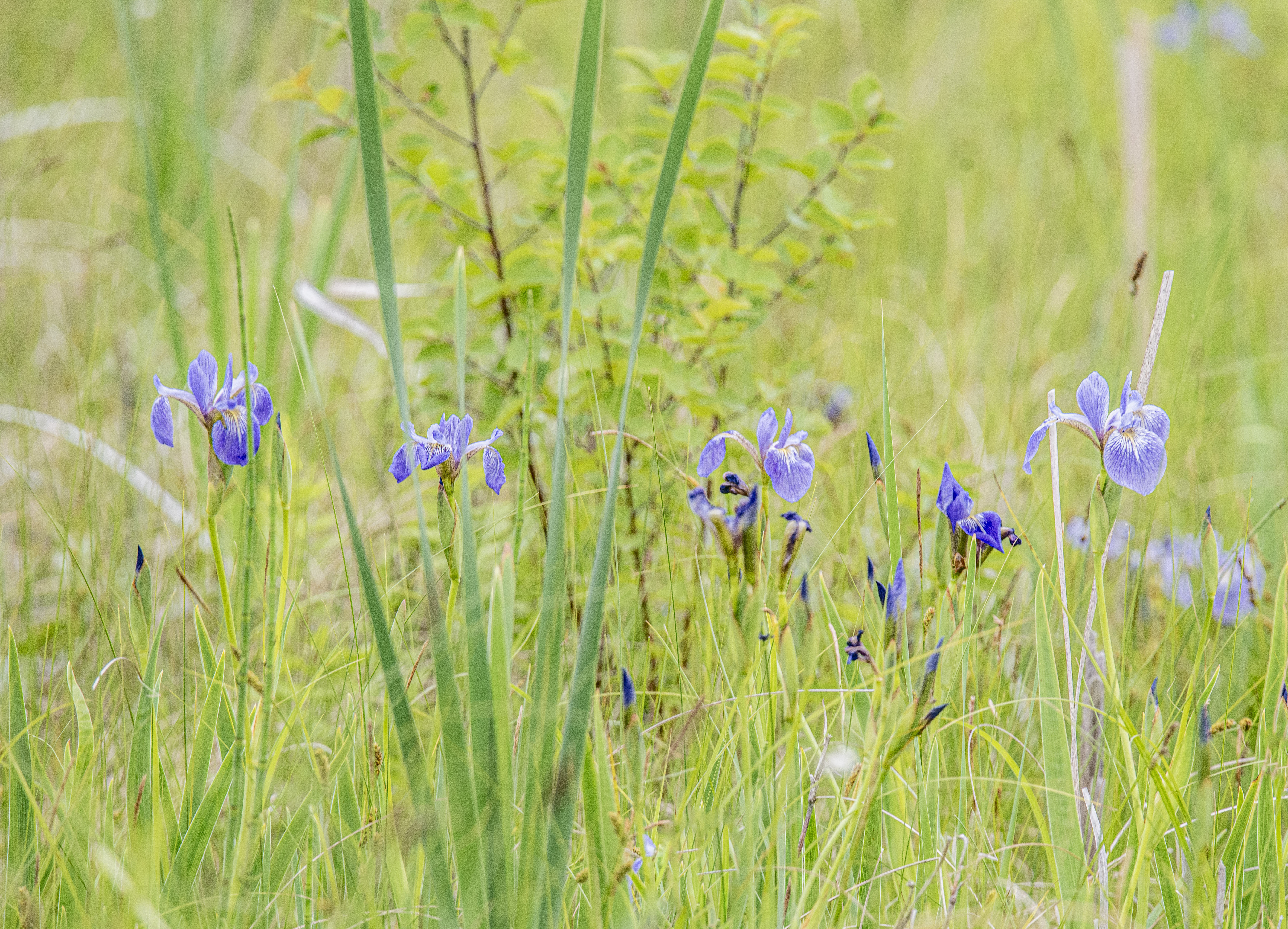
Several years ago while driving toward Blackbird Trail, that winding sweetheart of a drive through the Tamarac National Wildlife Refuge near Detroit Lakes, my eye caught a lone beauty of an interesting flower that I couldn’t believe was either “native” or “wild.” Yet there stood a beautiful lone blue iris, radiating and standing tall against the greenish nearby native marshy plants … with exception of the adjacent gangly cattails.

Was this some sort of garden remnant? Did someone luckily hoist a bulb into the marsh from the graveled road? 

After returning home a little research confirmed the identification, noting that Minnesota actually has two closely related “Blueflags” or native blue irises with territories divided on a loose geographic border drawn horizontally across the state from our largest city. Iris versicolor is the northern and predominant species from the Twin Cities up into Canada while Iris virginica similarly reaches from the Twin Cities south toward the Texas coast. 

According to the scientific explanation the upstate species is typically more richly pigmented on the outer sepal edges, fading lighter towards the “throat” with veins prominently tinted toward a faded greenish yellow. While microscopic characteristics might cause a botanist to giggle, the northern iris is typically a darker blue than its faded cousin. There! Science has spoken. 

Now here is a bit of poetry, thanks to Margaret Atwood’s “The Handmaid’s Tale” — “Then we had the irises, rising beautiful and cool on their tall stalks, like blown glass, like pastel water momentarily frozen in a splash, light blue, light mauve, and the darker ones, velvet and purple, black cat’s ears in the sun, indigo shadow, and the bleeding hearts, so female in shape it was a surprise they’d not long since been rooted out.” 

Science, or blown glass like a pastel splash of velvity water, these beauties stand awash in the nearby greenery of Tamerac, catching a wandering eye like a thin metal washer drawn instantly to a demanding magnet.

While we had a free day and a will of once again hopefully capturing blooms of both the yellow and showey ladyslippers that bless this northern refuge, I also held hope that we might catch the wild blue of irises in bloom. All three wild flowers came through splendidly along with a host of other colorful wild flora. We were blessed. 

Not so much by the fauna, however. Not one songbird, including the fluttering and shy warblers, allowed me a moment. While the swans were cooperative, we had some near misses along the way: a grouse with three chicks slithered like spies deep into the trail grasses before scooting out to escape my hungry lens into the dense woods. This was just moments before I caught sight of a beaver in my rear-view mirror tugging a six foot willow branch by the clamp of his teeth while charging across the motor trail in a beaverish waddle. Like the spy-like grouse, it dragged the branch through the dense woody underbrush while successfully remaining obscured by the leafy branches. We then came over a rise to find a bald eagle posed perfectly on a branch of a dead tree. I quickly raised the camera although apparently not rapidly enough. My image was of the perfectly weathered grayish branch, a bunch of blue sky and the feet and butt of the rising raptor. Ah, but those wild irises!

It was in the midst of all that commotion that we finally came across the irises. In three distinct locations, each marshy, each different and distinct from the other. On our last sighting a broad curved broad grassy looking leaf of a plant would have made a nice arc over two near perfect younger blossoms. Without hip boots, though, my idea of making an image with a composition of the plants beneath the arc of leaf simply didn’t work. A thought of wading into the marsh with the hordes of mosquitoes was as much of a deterrent as was the possibility of sinking knee deep into the muck. Even laying onto the gravel didn’t provide the angle I envisioned. It was what it was. Welcome to nature. And those were the last of the dozens of irises we came across.

Our first batch was quite numerous, and I actually let out an exclamation of delight when they initially came into view. Time had played a role in their aging, however, with spent blossoms hanging blackish along with those struggling to grasp their fading beauty. What can one do when faced with these situations in nature? You simply do what you can. Between this incredible array of blossoms and those arching above the arc, we found another set that hadn’t aged so distinctly. Being partially shaded, it seemed, might have helped. This batch allowed me to play with light and depth of field, those tools of our odd trade. Perhaps too much time was spent attempting to create a bit of art from such a wonderful blessing of nature.

Yes, it was delightful to once again see the rich blues of the irises, along with the white and pink of the showeys. Those vivid colors of the yellow ladyslippers and the bright crimson of the columbines added joy as well. My partner, Roberta, suggested on our way home that I was smiling. Internally there was certainly a sense of peace and joy, that those six hours of drive time had been well worth the effort. 

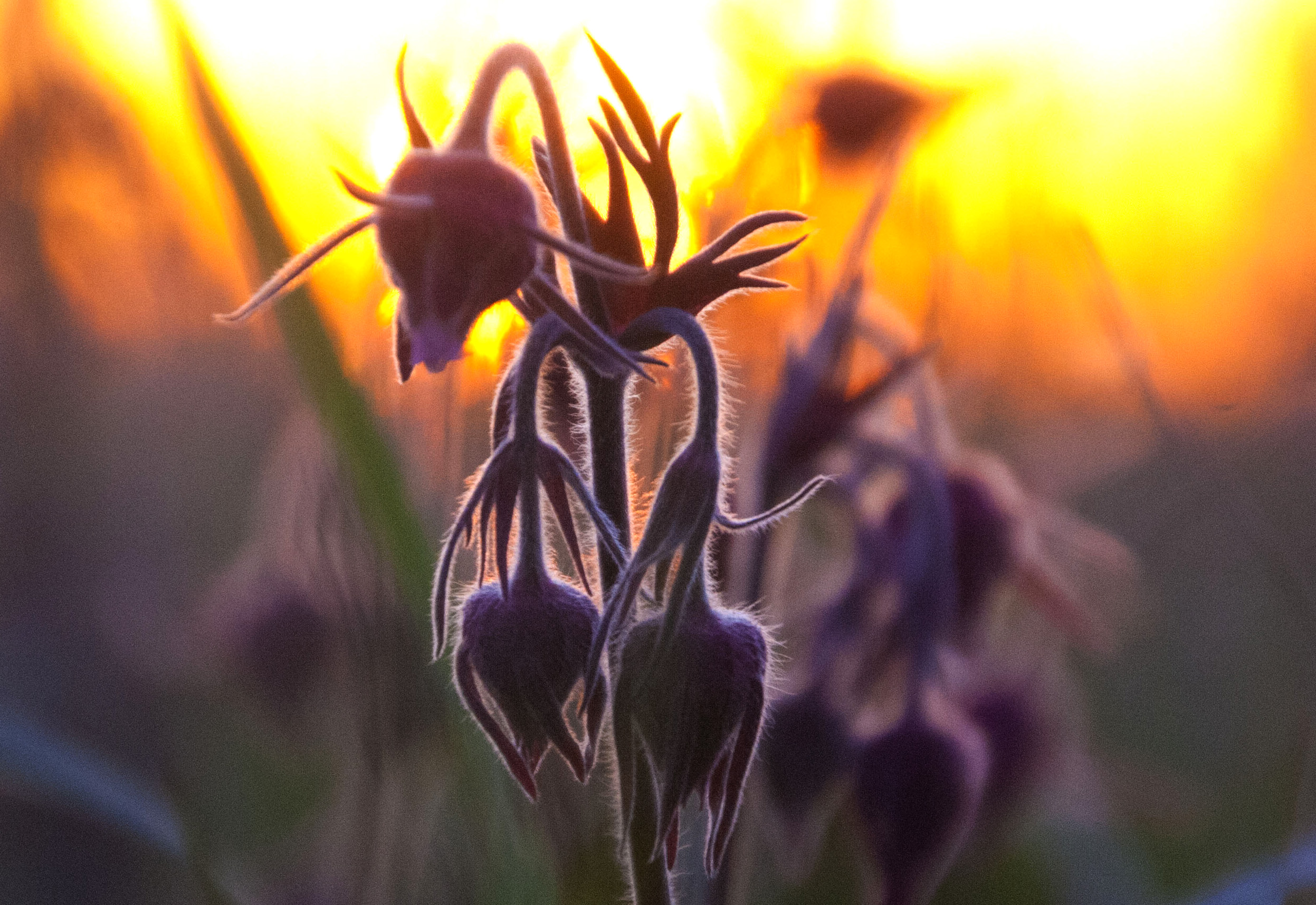
Sometimes these seasons I photograph, be they birds, trees, prairie grasses or native flowers, help me check off a mental list. Do I need more images of wild turkeys fluffed in sexual desire, or the first poking of pasque flowers through dormant grasses after another long and dreary winter, or of those lady slippers I chase from the prairie to the northern woods as was the reason for this drive, or even the pastel waters of little black cat’s ears in the sun? As a naturalist and photographer, though, these are seasons of life, of nature, of the knowledge that for one more year all is surviving nicely in the natural world. Myself included. So yes, I was smiling! 

A Letter of Love

Dear Audrey and Asa:

Although you don’t know one another you have more in kinship than you perhaps realize. Ties with Italy comes to mind, although I write of a deeper kinship appreciation for each of you. Audrey, you blessed me years ago with the sense of hope that is celebrated on the shortest day of the year, while you, Asa, convinced me of the joy in celebrating the gift of life on summer’s longest day. Two solstices a half year apart. 

Believe me, you two strong and beautiful women of commitment, grace and joy, who have devoted both your private lives and careers to the betterment of all mankind and our planet, for you have each humbled me. Through the years I’ve tried to honor your gifts by capturing imagery to express those two necessities of life.

2025

You, Audrey, came as a prairie activist offering a glimpse and an appreciation of a geological past that now haunts us deeply … if we are simply aware enough to pay heed to the mere ghosts of a distant geological past. Back when grasslands stretched across the lands of what is now a vast nationwide patchwork of commodity crops, back when meadowlarks and bobolinks were as common as household sparrows, when visions of bison and antelope seemed on par with today’s white-tailed deer, and when prairie wetlands dotted the landscape as numerous as the clouds they reflect on days of perfectly calm waters. Yet, it was even a deeper past that touches me in the darkness of Decembers … that of light, of a pagan celebration that acknowledges the coming of days of longer light, of hope. 

You and Richard Handeen have religiously built huge bonfires on your rural Montevideo organic farm where we hovered besides burning logs to roast thin slices of venison and huddled close to the flames reaching skyward into the vast darkness. Usually you provided us with two large fires. One near your warm summer kitchen, often filled with music being created, and one deeper into the woods where we sat on straw bales with mugs of Cabernet and glanced through naked tree limbs for glimpses of the moon or those telling stars of Orion. Over the years as my sons grew into adulthood, your Winter Solstice bonfires and camaraderie rivaled Christmas.

2024

Certainly the celebration of hope on this long, dark night grasped my interests long before meeting Asa. I now marvel of how well you two could be sisters, each aiming for hope while reaching for a clearer and better world despite the many obstacles, of how you each give tokens to both the openness and closures of the light of life. 

Asa, you came to us when we were regional coordinators for EF Foundation for Foreign Studies, a non-profit that brought high school aged exchange students to the States, of providing a sharing of family life with a stranger from another culture as if the teenager was one of our own. That’s what happened, time after time. And it was during this time, especially during the heady summer work of finding willing and suitable host families that you invited us to EF’s Boston headquarters for encouragement and, yes, a celebration of your dear Swedish Mid Summer tradition. That nod to light and joy. The Summer Solstice! Most of those celebrations were held in the EF headquarters along the Charles River and across the bridge from downtown Boston. One memorable summer you took us to your home where Rufus did the culinary honors. 

2013

A Summer Solstice comes just a few days before the anniversary of the passing of Sharon, my wife of 32 years. For me there seemed a link between the two and I started looking back at those celebrations with both joy and admiration while seeking a deeper awareness of light. Sharon would have loved those Mid Summer moments when chairs replaced hay bales, and sunshine held off darkness as glasses were clinked and smiles and fellowship were shared with friends from around the world. So I thank you, Asa, for that correlation, for that way of celebrating not just the light and joys of life, but also the memories of the brightness of being.

Nowadays I make an effort to honor the Summer Solstice in much the same manner as I have the Winter Solstice. For both I find myself “chasing” light to in some way capture the essence of light and nature in a form of positive joy.; to create an image I believe you each might want to hold for a moment, to perhaps smile and offer a word of grace and fellowship between that light, nature and mankind. 

2021

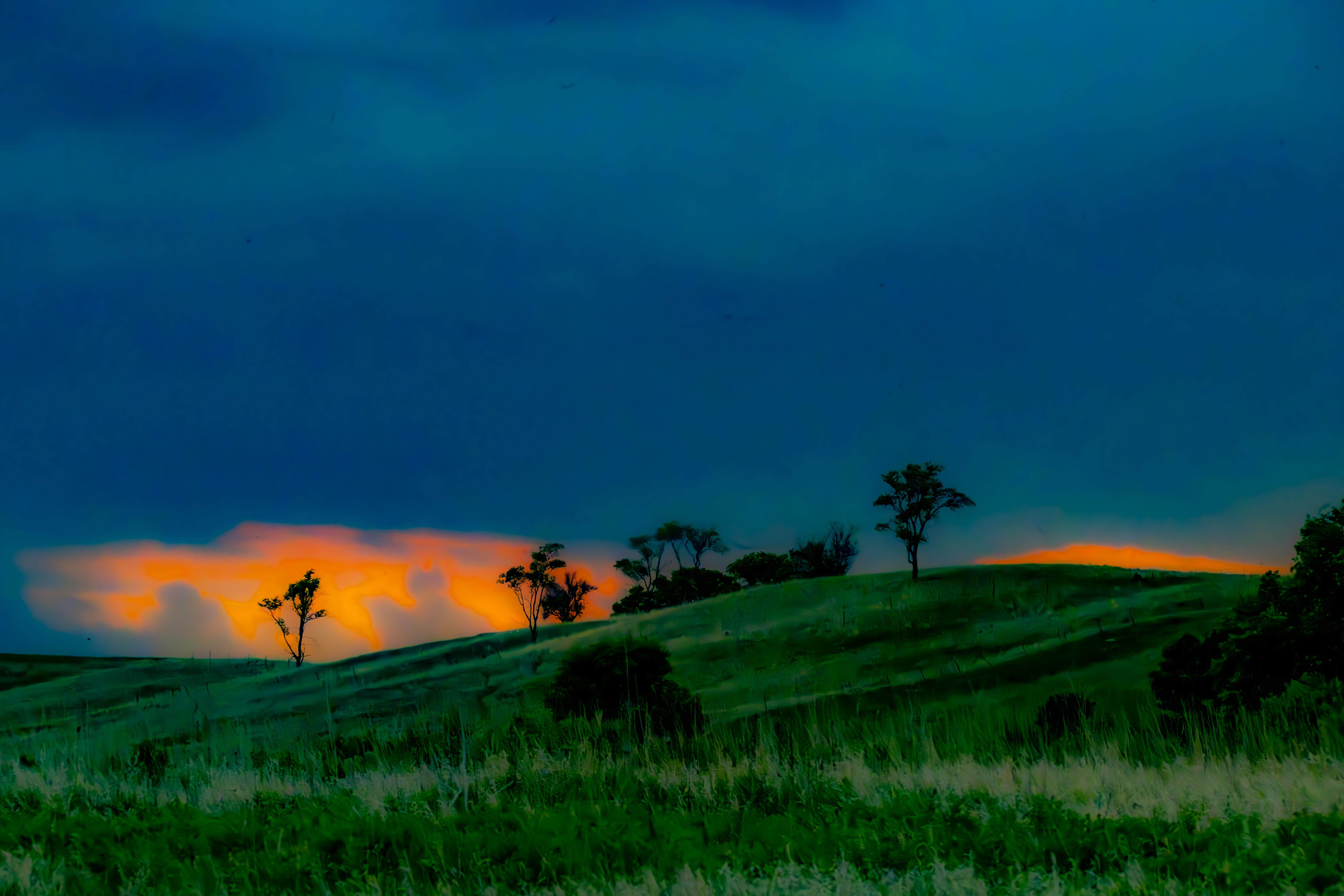
Hopefully in a some small way this capturing of light, the essence of our sun, comes across pleasantly and with the joy intended. Rarely do I begin my effort with a particular image in mind, although my Summer Solstice this year began with a lone tree on a prairie hillside. Would the sun lower in a way that would create an interesting image? Would the composition work? Would the stand alone tree be bathed with joyful light? Would joy be portrayed?

While all that might seem strange I can recall at least two instances when trying to capture light for a Winter Solstice came down to a momentary and sudden glimpse of colorful light mere moments before the darkening dusk. Struggles have occurred with the Summer Solstice imagery, too. A grouping of hovering swallows were caught in a near circle above the Minnesota River to save one day, and over the year storms have entered the pictures. But, isn’t that something you might expect in life? Despite all of our will to celebrate? Be it hope or joy? That there are storms?

2015

It has been a long while since I attempted a “love” letter, and this one is perhaps a measly attempt at one. Yet I feel I owe you each an appreciation for your individual efforts for the betterment of our lonely planet, especially in these times of national and international turmoil. I feel I owe you each a great deal of gratitude for making me notice a need to appreciate and celebrate both hope and joy. Aren’t those are what the celebrations of the two solstices are about?

Sincerely,

Your Friend Forevermore

Flirting With Destiny

Was destiny in the cards? Serendipity? On a morning when I felt it best I be out of the house I ended up in familiar digs, leaving a favored fishing spot to raise my camera once again in nature. Funny how that works. This venture began with an eye toward an eagle’s nest near the Marsh Lake dam, one I’ve photographed a few times over the past several weeks. This is a haunting setting, a nest built high within the branches of a weathered and whitened row of cottonwoods alongside the wetland. Weathered and whitened cottonwoods line both sides of the slough.

Although the rain hampered the vision somewhat it was still easy to see the eaglets that are now perhaps as large as their parents. Both were hopping on the gigantic wooded nest, stretching their broad wings high and wide. Briefly I wondered if one would actually take flight. Across the wetland the parents were perched side by side keeping eyes on the youngsters across the way.

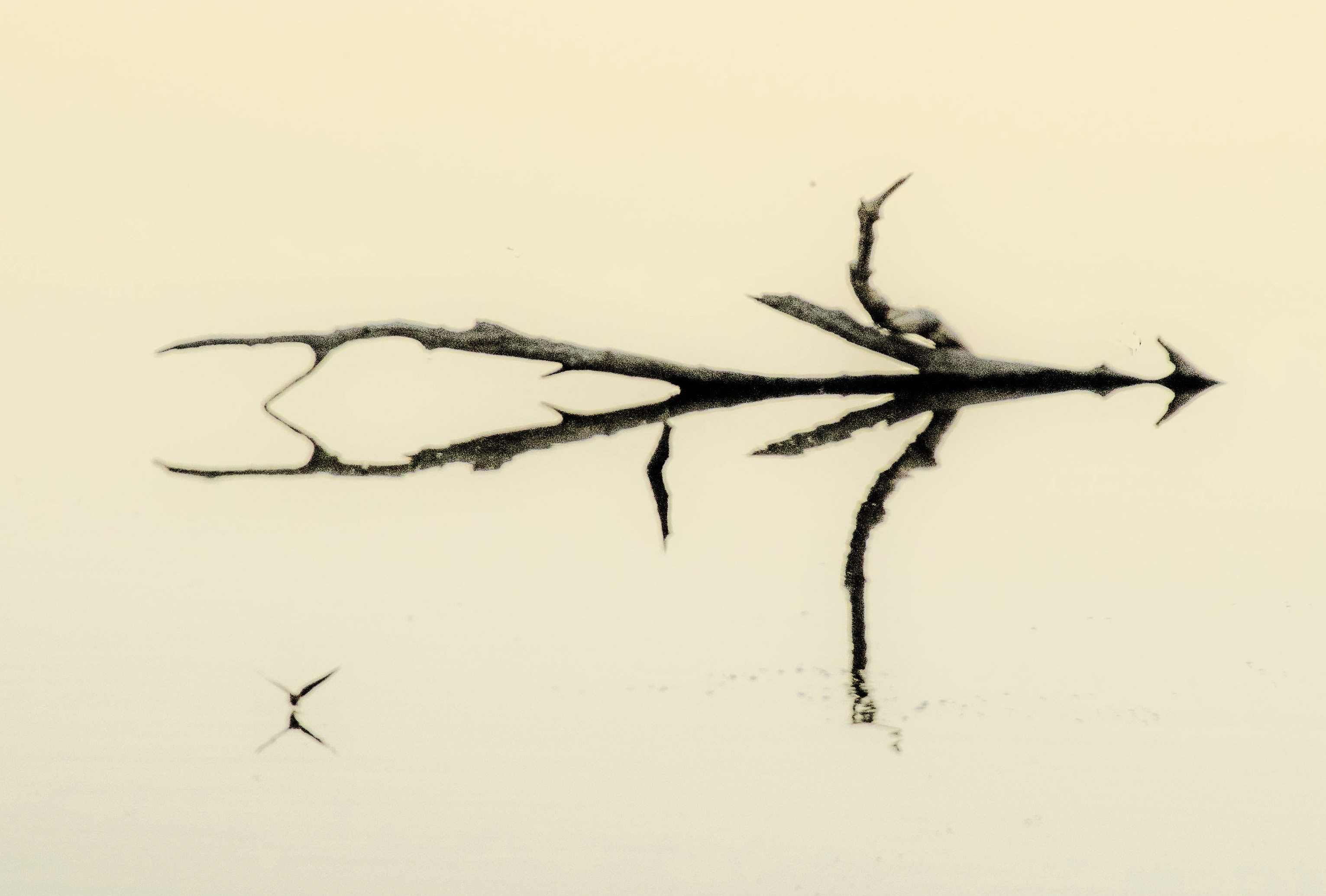
Swallows were buzzing around, and I loved the old log and its reflection. Would a swallow do a dip? Yes! `Stark and simple.

Then it was to the dam itself where I quickly became engrossed in trying to capture Black Terns dipping their beaks into the surface of the Minnesota River. A few weeks ago at the Sand Lake NWR I just missed capturing a swallow doing the same. In the midst of working the terns a glance skyward caught a huge pod of white pelicans gliding gracefully overhead toward Marsh Lake. Trying to capture an image from inside the cab of the pickup tested my recent lack of yoga. 

An umbrella of densely packed clouds were joined by rain pelting the windshield as I headed up the rise toward the fish-bone-surfaced gravel road. A quick glance across the lake revealed a vast horizon of acres of deep green vegetation stretching across the formerly carp infested shallow waters. A shrouded haze stretched across the vegetated waters as my thoughts turned to capturing a long string of gliding pelicans, their white bodies and black wing tips easing across this plain of aquatic flora, contrasting with the green foliage and bluish haze.

It was author Shiva Negi in his “Freedom of Life” who suggested that intention determines destiny. Would this be the time and place?

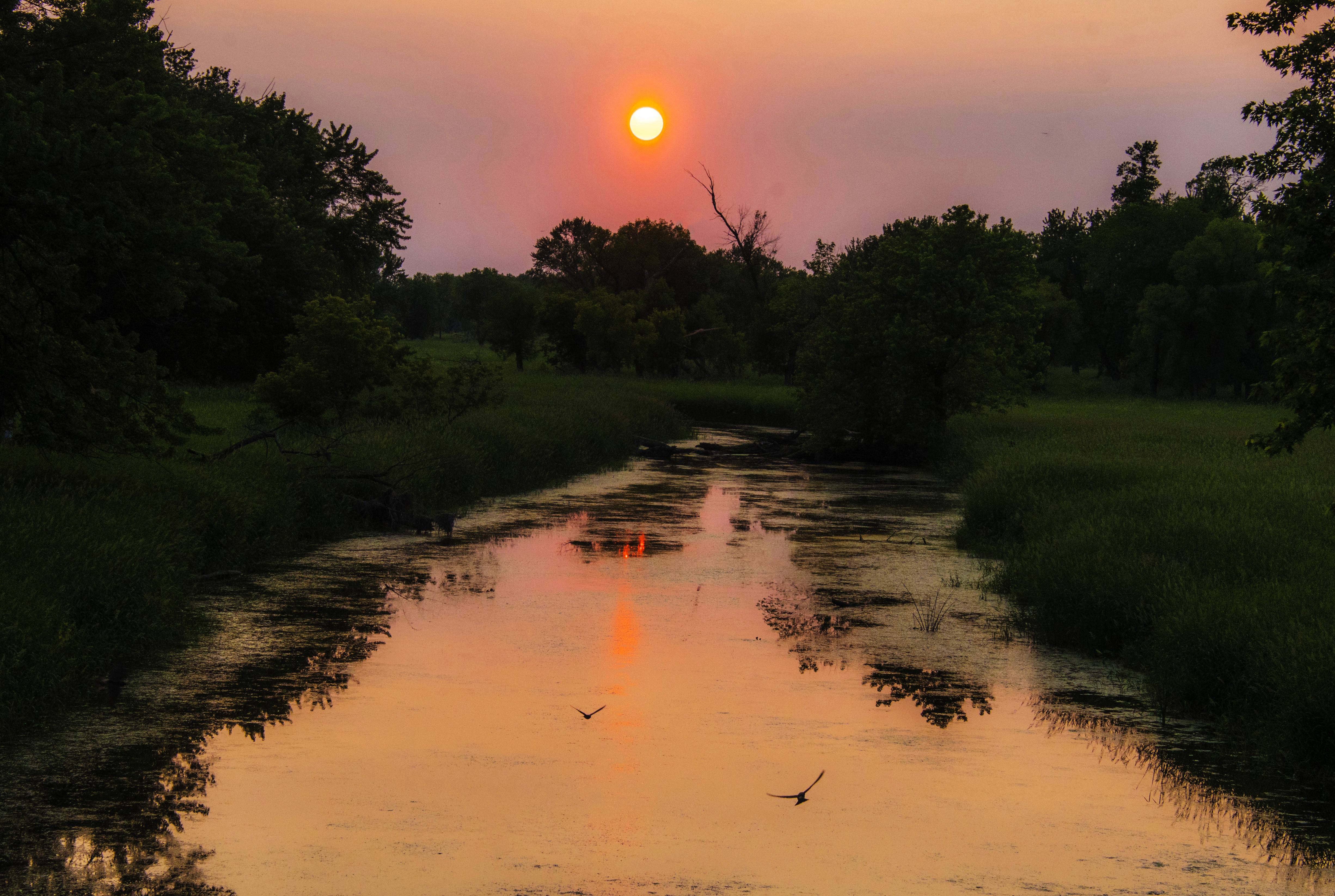
A sunset over the headwaters of the Minnesota River was blessed by two swallows, an anxious wait since the sun was sinking quickly.

While holding that thought I tucked tail and headed past the eagles toward down the county gravel. Thanks to my dear partner, Roberta, and her desire for “new roads,” I took a left at the “T” thinking I might be closer to the highway home than if I took my normal route. It was a dead end, so I maneuvered the pickup around and headed back toward the Marsh Lake road. Does intention determine destiny? There it was again, so I turned back onto the dam road to see if perhaps another pod of pelicans might glide across the lake toward the island they inhabit. That mix of stark green and bluish haze was just too strong to pass up. After  arriving at the dam, I backed the truck down the pathway on the dike and eased the window down to wait.

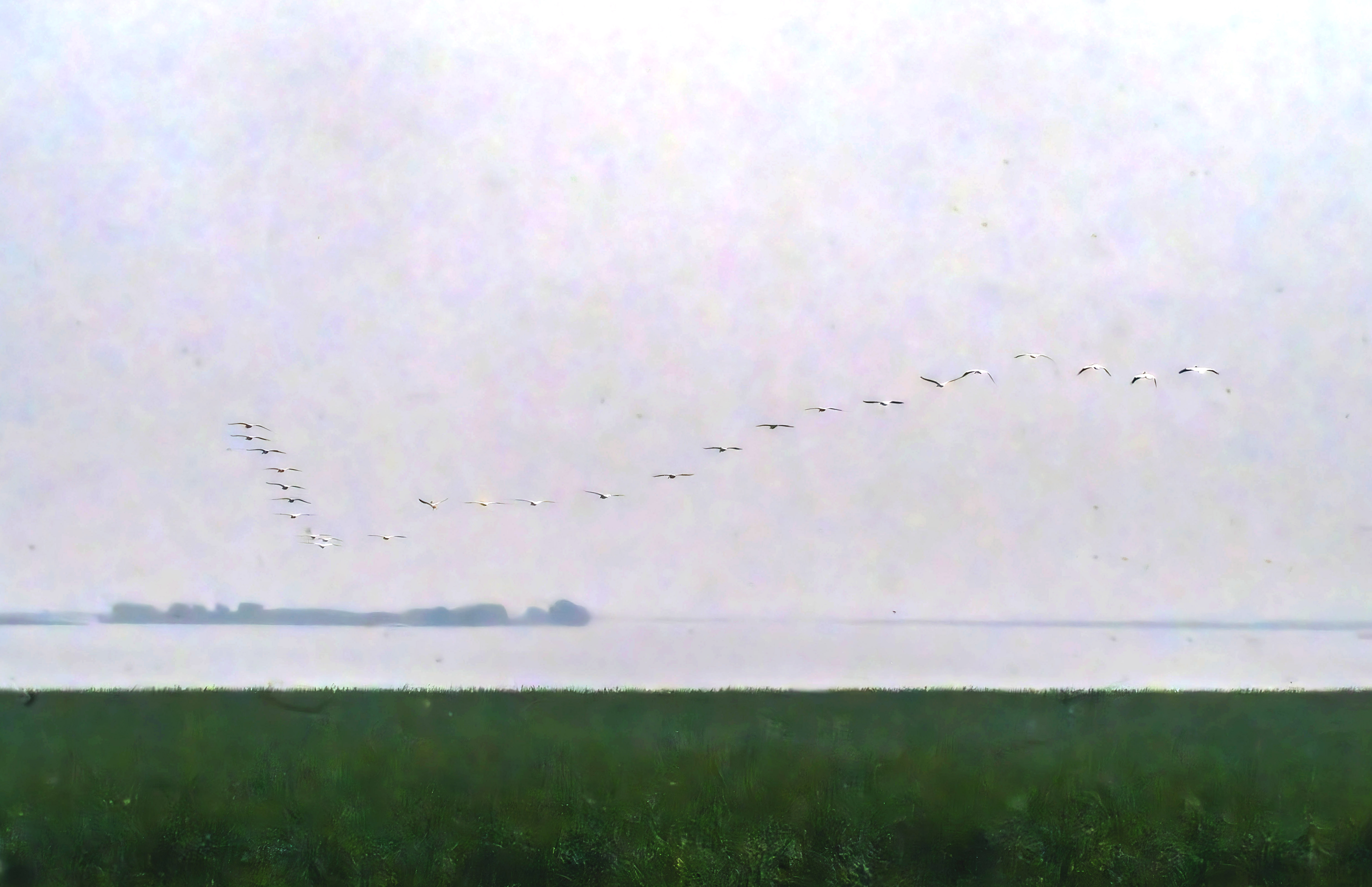
Within moments another long and sweeping pod of pelicans came easing across the windshield, stretching long across the horizon just as I had imagined. And, yes, they were headed up the lake in a near perfect composition. Destiny? Serendipity? Nature in perfect symmetry and harmony; an image that spoke of natural poetry!

Serendipity, for this was simply a beautiful surprise finding the swallows so perfectly placed!

Moments later, as I was heading home, thoughts of how various species of birds have blessed my images over the years by inexplicably turning mundane landscapes toward a higher level. Each time, I recalled, it was a matter of melding the natural composition with the help of some natural avian enhancement. Over the years I’ve had great help from swallows. Twice near the headwaters of the Minnesota River, and again on a foggy morning over Stoney Creek just east of Ortonville. 

Two old photojournalism adages came to mind: Animals, be they human, birds or otherwise, are creatures of habit, so if they do something once they most likely will do so again; and, always be prepared by planning your image around available light and composition. Those pelicans were a case in point, but so was focusing on a floating log believing a swallow would once again dip to sip nearby. Could I await the cruising swallows during a beautiful and calm sunset at the headwaters of the Minnesota River?

Serendipity? I believe this differs from destiny because it is typically just blind luck. Which brings me to the sweet swallows that somehow miraculously appeared in my Stoney Creek image. It wasn’t until I was back home processing a morning shoot that I actually noticed two swallows perfectly situated within the image. Even without their help, the composition, lighting, snaky fog hovering over the bend of this shallow creek would have made a fine image. That pair of swallows took it to another level. Pure luck!

Destiny? As if Negi was correct on his definition of the word, the pelicans appeared to ease across the Marsh Lake horizon!

That, I believe, is the difference between the two. There isn’t much you can do about serendipity while destiny requires knowledge, patience and a will to succeed. Certainly there is some luck involved. Would another pod of pelicans come back over Marsh Lake that morning? Having seen two different pods fly in that direction gave me hope that another on might come through. I was more than willing to wait awhile, and truthfully, it was less than a minute after I’d parked. This was one time when patience wasn’t needed. I knew the image I wanted and had placed myself in position if and when it might happen. 

Just as Negi had proposed. My intentions had won out resulting in a pleasing image. No, this wasn’t the first time where my feathered friends have helped me create an image that I’d mentally conceived, and I can’t thank Mother Nature enough for all these gifts and blessings she has granted me through the years. Certainly I’ll take serendipity when offered, yet I’ll opt for destiny when intensions are warranted.